
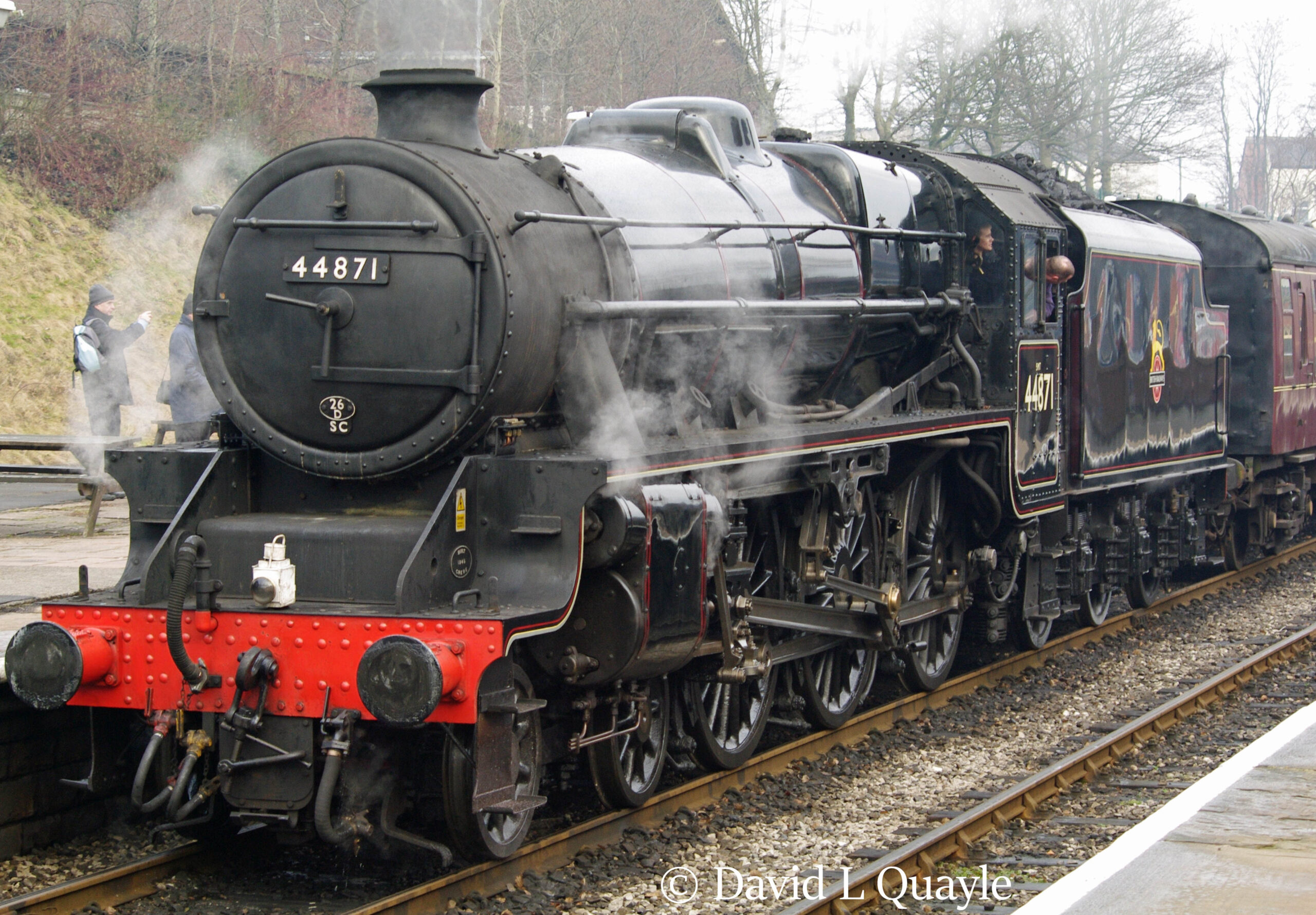
LMS Black 5 No. 44871 is one of the most famous surviving British steam locomotives and a remarkable representative of the highly successful LMS Stanier Class 5 4-6-0, better known to railway enthusiasts simply as the “Black Five.” Built during the final years of the Second World War and surviving into the very last days of British Railways steam operation, 44871 occupies a special place in British railway history. Its story reflects not only the success of the Black Five design itself, but also the wider transition from the steam age into preservation and the modern heritage railway movement.
The locomotive was designed as part of the famous LMS Black Five class by Sir William Stanier, one of Britain’s most respected locomotive engineers. Stanier became Chief Mechanical Engineer of the London, Midland and Scottish Railway (LMS) and sought to create a reliable, versatile locomotive capable of handling both passenger and freight duties. This “mixed traffic” concept meant the engine needed enough speed for express passenger trains while also possessing enough pulling power for heavy goods work.
The result was the Black Five, first introduced in 1934. It quickly became one of the finest examples of practical locomotive engineering in Britain. With a 4-6-0 wheel arrangement, 6-foot driving wheels, boiler pressure of 225 psi, and a tractive effort of 25,455 pounds, the Black Five proved powerful, dependable, and easy to maintain. A total of 842 were built, making it one of the most numerous and successful British steam locomotive classes ever produced. Their black livery and BR classification of 5MT gave rise to the now-famous nickname “Black Five.”
No. 44871 was originally built as LMS No. 4871 at Crewe Works in March 1945, near the end of the war. It was among the later members of the class and represented the mature form of Stanier’s design. Like many locomotives of its era, it was constructed not for glamour but for hard daily service. Britain’s railways were under immense strain during wartime, and locomotives such as 4871 were expected to work long hours hauling troops, freight, coal, and essential passenger services.
Under LMS ownership it carried the number 4871, but after nationalisation in 1948 and the formation of British Railways, it was renumbered 44871, following the standard BR numbering system that added 40000 to many former LMS locomotives. This is the number by which it is now best known.
Throughout its British Railways working life, 44871 served as a true mixed traffic engine, hauling a wide variety of trains across the network. Black Fives were famous because they could be sent almost anywhere and asked to do almost anything. They were not the most glamorous express engines like the Pacifics, nor were they the heaviest freight machines, but they were perhaps the most useful. Drivers and crews respected them for their reliability, while railway managers valued their flexibility.
What makes 44871 especially significant is that it survived until the very end of steam traction on British Railways. By the 1960s, diesel and electric locomotives were rapidly replacing steam across the country. Steam withdrawals accelerated, and many once-famous classes disappeared forever. Yet the Black Fives lasted because they were so useful, especially in the North West and on the London Midland Region, where steam remained longest.
44871 became one of the last steam locomotives still in regular service. Its most famous moment came on 11 August 1968 when it took part in the legendary “Fifteen Guinea Special,” the final officially operated steam-hauled passenger train on British Railways. This railtour marked the symbolic end of the steam era in Britain and has since become one of the most celebrated events in railway preservation history.
44871 worked the Carlisle to Manchester Victoria section of the special, double-heading with sister locomotive 44781 over the famous Settle and Carlisle route. In this role, 44871 acted as the pilot engine while 44781 was the train engine. Thousands of enthusiasts lined the route to witness the end of an era. For many, it was an emotional farewell to a technology that had shaped Britain for over a century. 44871’s participation ensured its place in railway legend.
The very next day, on 12 August 1968, locomotive 44871 was officially withdrawn from service. Unlike many locomotives that were sent for scrap, 44871 was fortunate enough to be purchased directly from British Railways for preservation by Dr Peter Beet and Graham Ellis. This meant it never had to suffer the indignity of scrapyard deterioration, unlike many preserved steam locomotives rescued from Barry Scrapyard years later.
Its preservation story began at Carnforth, which later became famous as Steamtown. When the ban on steam locomotives operating on the national network was lifted in the early 1970s, 44871 was one of the locomotives that returned to active service. In 1972 it returned to steam and once again hauled trains on the main line, proving that the steam age was not entirely over.
During this preservation era, the locomotive briefly carried the name “Sovereign,” although enthusiasts generally continued to know it simply as 44871. It became a popular performer on railtours and heritage operations, particularly in the North West and Scotland. One of its best-known regular duties became working trains on the scenic West Highland Line between Fort William and Mallaig, including the famous Jacobite service. This route, with its dramatic Highland scenery and the iconic Glenfinnan Viaduct, gave the locomotive a new generation of admirers.
Like all steam locomotives, 44871 required periodic heavy overhauls. Steam engines are not simply maintained forever; boilers expire, motion wears, and certification standards are strict—especially for main line operation. After years of use and periods of storage, the locomotive was purchased in 2006 by Ian Riley of Ian Riley & Son, one of the best-known names in British steam locomotive restoration.
A major overhaul followed, restoring the engine to full main line standards. It returned to steam in 2009 and resumed work on heritage railways and main line excursions. Another heavy overhaul was completed in 2017 to ensure continued certification and reliability. Today, it remains operational and mainline certified, a significant achievement for a locomotive built in 1945.
The locomotive is now based largely at the East Lancashire Railway when not working main line duties or Jacobite services. It continues to haul charter trains across Britain and remains a favourite among enthusiasts due to both its historical importance and its classic Black Five appearance.
Technically, 44871 remains a strong example of practical steam engineering. It has two outside cylinders, Walschaerts valve gear, piston valves, a tender carrying nine tons of coal and 4,000 gallons of water, and retains the rugged, straightforward design that made the class so successful. Modern safety systems such as AWS, TPWS, OTMR, and GSM-R have been fitted so it can operate safely on today’s national railway network alongside modern trains. This blending of 1940s engineering with 21st-century railway safety technology is a fascinating example of preservation in action.
Beyond engineering, 44871 has also entered popular culture. It appeared in an episode of the television programme Coronation Street, hauling Roy and Hayley Cropper’s wedding train. Such appearances help keep steam locomotives visible to the wider public, not just railway enthusiasts.
In many ways, 44871 represents the entire story of British steam railways: wartime construction, hard everyday service, survival into the final days of steam, participation in the last BR steam special, rescue through preservation, and continued operation in the heritage era. It is not merely a locomotive but a living historical artefact.
Unlike museum exhibits that stand silent behind barriers, 44871 still works for its living. It breathes, steams, whistles, and pulls trains just as it did decades ago. Watching it depart under load—smoke rising, exhaust barking, rods flashing—is not simply seeing a machine in motion; it is witnessing history alive on the rails.
For railway enthusiasts, the sound of 44871 climbing a gradient or crossing a viaduct is a direct link to Britain’s industrial past. For younger generations, it is a chance to experience steam not as history in a book, but as something real and powerful.
LMS Black 5 No. 44871 therefore stands as one of the most important preserved steam locomotives in Britain: not because it was the fastest or most glamorous, but because it was one of the best examples of the dependable workhorse that kept Britain moving—and because it survived long enough to say goodbye to the steam age before helping to preserve it for the future.
