
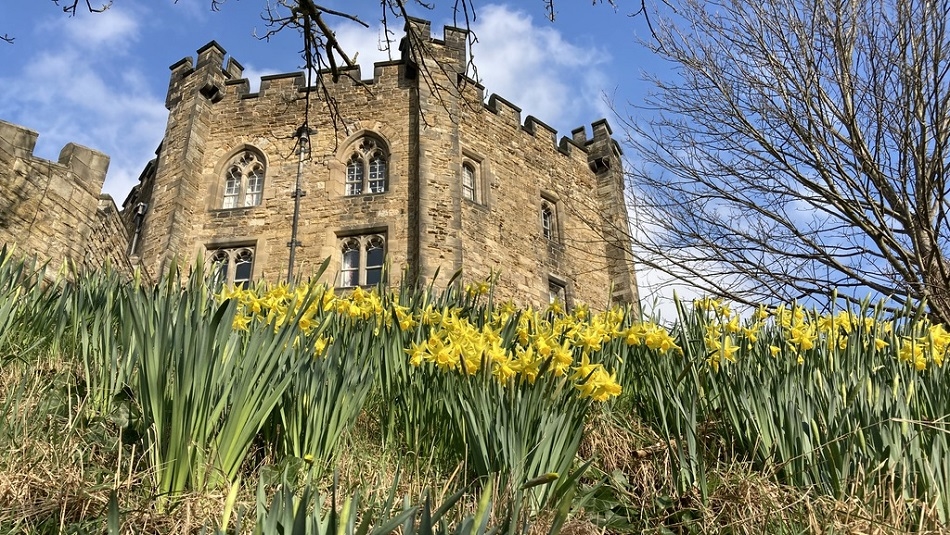
Durham Castle stands as one of the most remarkable historic landmarks in the North East of England, dominating the skyline of Durham alongside the magnificent Durham Cathedral. Positioned high above the River Wear on the dramatic peninsula at the heart of the city, the castle is not only an architectural masterpiece but also a symbol of political power, religious authority, and centuries of English history. Visiting Durham Castle is far more than simply touring an old building—it is an experience that brings the medieval world vividly to life.
The first impression of Durham Castle is one of strength and permanence. Its thick stone walls, imposing towers, and elevated position immediately reveal its original purpose as a fortress. Built shortly after the Norman Conquest of 1066, the castle was established by William the Conqueror’s forces to secure control over the north of England. Durham was a strategically important location, particularly because of its proximity to the Scottish border, and the Normans needed a powerful military stronghold to maintain authority in the region.
Construction of the castle began in 1072 under the supervision of Walcher, the first Norman Bishop of Durham. Like many Norman castles of the period, it was designed to demonstrate control as much as provide defence. Its position overlooking the city and surrounding landscape was deliberate—it was meant to be seen, and its presence sent a clear message of power. Over time, the castle developed from a military fortress into a residence for one of the most unusual and powerful offices in medieval England: the Prince Bishops of Durham.
The Prince Bishops were unlike ordinary bishops. Because of Durham’s border location and political importance, they were granted extraordinary powers by the Crown. They could raise armies, appoint officials, administer justice, collect taxes, and even mint their own coins. In many ways, they ruled Durham almost like independent princes, balancing both religious leadership and secular governance. This unique status made Durham Castle not simply a bishop’s residence, but the administrative heart of a semi-autonomous territory.
Walking through the castle today, it becomes clear that this was a place where major decisions were made. Every hall, staircase, and chamber reflects the importance of authority and governance. Yet despite its political role, there is also a strong sense of domestic life within the castle. It was both a fortress and a home, and that dual purpose gives the building much of its character.
One of the most fascinating parts of Durham Castle is the Norman Chapel, one of the oldest surviving sections of the building. Dating from around 1078, it remains remarkably well preserved and offers a rare glimpse into early Norman architecture. Hidden beneath later additions to the castle, the chapel feels almost secretive, tucked away from the grander public spaces above.
The chapel is simple and powerful. Thick stone columns support low arches, and the carved capitals show early decorative work that still survives after nearly a thousand years. There is no excessive ornamentation—its beauty lies in its solidity and quiet atmosphere. Standing in the Norman Chapel, there is an overwhelming sense of age and continuity. It is easy to imagine generations of bishops, clergy, soldiers, and residents passing through the same space, offering prayers or seeking moments of reflection.
Unlike the grandeur of a cathedral, the chapel feels intimate. It reminds visitors that castles were not only centres of politics and defence, but also places where faith shaped daily life. Religion was inseparable from governance in medieval Durham, and the chapel reflects that connection perfectly.
In contrast to the simplicity of the chapel, the Great Hall demonstrates the castle’s role as a centre of authority and ceremony. Large, impressive, and designed to command attention, the hall was where banquets, official gatherings, and important events took place. The size of the room alone reflects the importance of hospitality and display in medieval life. Power was often communicated through ceremony, and the Great Hall would have been one of the most important spaces for that purpose.
Today, the Great Hall still serves a significant role, though in a very different context. Durham Castle is now part of University College, Durham University, and students live and study within the historic walls. The Great Hall functions as a dining hall, where formal dinners continue a tradition of communal gathering that stretches back centuries. This transformation from medieval fortress to academic residence is one of the most unique aspects of Durham Castle.
Rather than becoming simply a preserved monument, the castle remains a living building. Students walking through ancient courtyards, dining beneath portraits and vaulted ceilings, and living in rooms shaped by history create a remarkable continuity between past and present. It gives the castle an energy that many historic sites lack. It is not frozen in time—it continues to evolve while retaining its identity.
Another memorable feature of the castle is the Black Staircase, designed in the 17th century by Bishop John Cosin. It is often described as one of the earliest examples of a grand staircase in England and reflects the changes in architectural style that shaped the castle over time. Made from beautifully carved oak, the staircase contrasts with the heavy Norman stone surrounding it, adding elegance and warmth to the interior.
The Black Staircase represents the castle’s long history of adaptation. Rather than remaining fixed in its original Norman form, the building was altered and expanded across centuries to reflect changing needs, tastes, and political circumstances. Medieval fortification gave way to more comfortable domestic architecture, and the castle gradually became less about military defence and more about status, administration, and residence.
Walking through the courtyards and passageways of Durham Castle, it is easy to notice this layering of history. Norman walls stand beside later additions; medieval stone meets Renaissance woodwork. Each period has left its mark. The building is not the product of one moment, but of continuous change over nearly a thousand years.
The castle courtyard itself is particularly striking. Surrounded by ancient walls and offering views toward Durham Cathedral, it creates a strong sense of place. Few locations in England feel so deeply connected to history. Standing there, with the cathedral rising beside it, the relationship between the two buildings becomes immediately clear.
Durham Castle and Durham Cathedral were never separate stories. Together they formed the centre of religious and political life in medieval Durham. The cathedral represented spiritual authority, housing the shrine of St Cuthbert and serving as one of the great pilgrimage destinations of medieval England. The castle provided the administrative and military power that protected and supported that authority. Side by side, they symbolised the union of church and state in a uniquely powerful form.
This relationship still defines Durham today. Visitors experience the city through that pairing—castle and cathedral, power and prayer, governance and faith. The UNESCO World Heritage designation reflects not only the beauty of the buildings themselves, but the historical importance of that connection.
One of the most interesting aspects of Durham Castle is how it reflects the broader story of England. It tells the story of Norman conquest, medieval politics, religious authority, Reformation change, and the rise of modern education. It is not just a local landmark; it is part of the national story.
During the English Civil War and later political upheavals, the castle’s role shifted again. The decline of the Prince Bishops and the changing balance between church and Crown altered its significance. Eventually, in the 19th century, the castle became part of Durham University, opening a new chapter in its life. This transformation from fortress to college reflects a broader change in society—from military and ecclesiastical power toward education and intellectual development.
That educational role feels particularly appropriate. Castles often symbolise power, but universities represent the pursuit of knowledge. Durham Castle combines both histories, creating a space where leadership and learning intersect. Students living there today become part of a much longer story, surrounded by centuries of responsibility and tradition.
What makes Durham Castle especially memorable is that it does not feel like a museum detached from life. It remains functional, inhabited, and relevant. The past is not sealed away behind glass; it exists in everyday use. Formal dinners still take place in the Great Hall, students still cross the courtyard, and visitors still stand in the Norman Chapel in quiet reflection.
There is something powerful about that continuity. Historic buildings often survive because they are preserved, but the most meaningful ones survive because they continue to matter. Durham Castle matters because it still serves a purpose. It remains a place of community, learning, and identity.
Leaving Durham Castle, there is a strong sense that the visit offers more than historical knowledge. It provides perspective. The castle reminds us that institutions endure when they are built with purpose and allowed to adapt. It shows how leadership, whether medieval or modern, is always tied to responsibility and legacy.
Durham Castle stands not only as one of the finest Norman castles in England, but as a living symbol of resilience and transformation. From the quiet simplicity of the Norman Chapel to the grandeur of the Great Hall, from the Black Staircase to the student rooms still in use today, every part of the castle tells a story.
For anyone visiting Durham, the castle is an essential experience. It is a place where history feels immediate and alive, where stone walls speak of centuries of power and change. More than just a tourist attraction, Durham Castle is a reminder that the past continues to shape the present, and that some buildings do far more than survive—they continue to inspire.
