
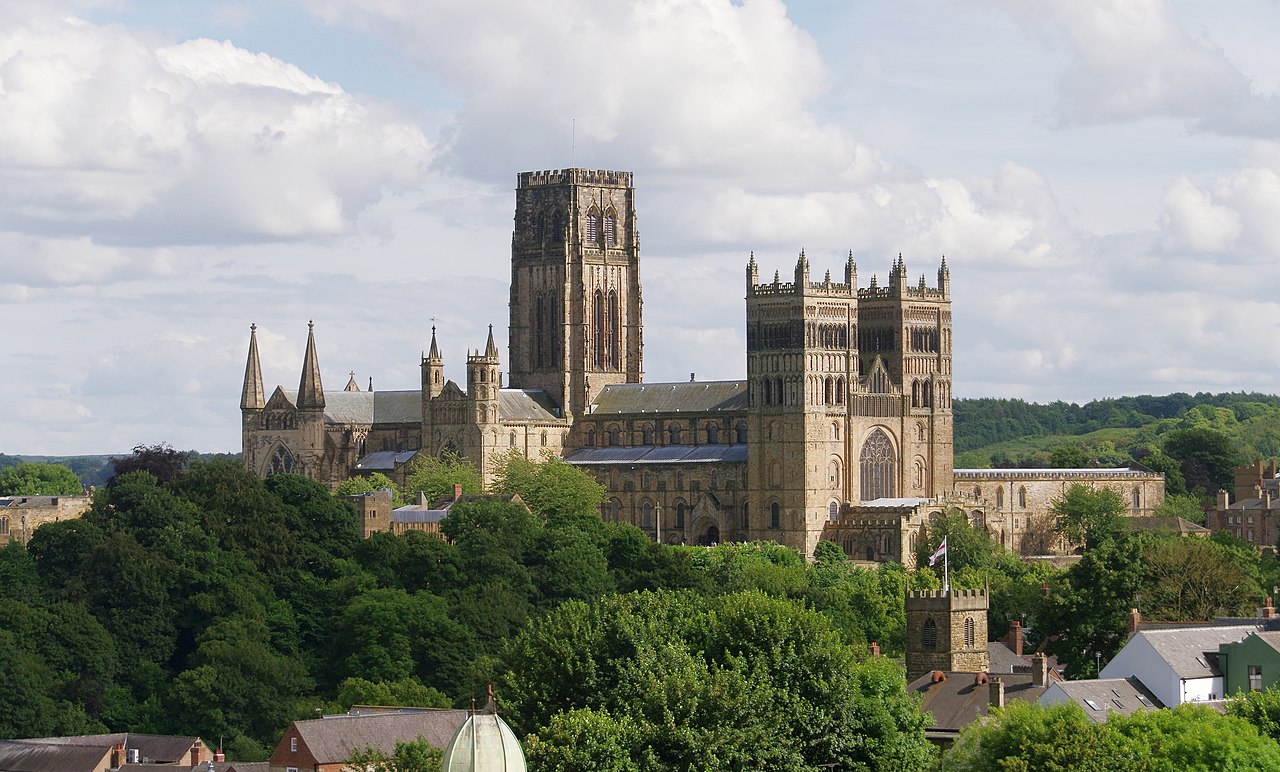
During my two-day attendance at the SME Leaders Masterclass hosted by Durham University Business School on the 23rd and 24th of April 2026, I had the opportunity to spend time exploring one of the most remarkable landmarks in the North East—Durham Cathedral. The course itself was held in the university’s impressive new Waterside Building, a modern state-of-the-art facility that reflects innovation, leadership, and forward-thinking business development. The SME Leaders Masterclass forms part of Durham University Business School’s wider “Smart and Scale Up” programme, designed to help regional SMEs grow, innovate, and develop stronger strategic leadership. It was an inspiring environment to be in, surrounded by business leaders, entrepreneurs, and professionals focused on development and progress.
After the day’s sessions, I decided to take full advantage of being in Durham by exploring the historic heart of the city. Having first visited Durham Castle as part of the tour, it felt only natural to continue the experience by walking across to Durham Cathedral, the towering Norman masterpiece that dominates the peninsula and skyline of the city. The contrast between the modernity of the business school and the ancient stone of the cathedral created a powerful sense of continuity—leadership and ambition framed by nearly a thousand years of history.
Durham Castle itself had already set the tone for the afternoon. Walking through its historic halls and courtyards gave a real sense of the political and religious importance Durham once held. The Prince Bishops of Durham wielded enormous power, and the castle reflected that authority. Yet it was when stepping out and approaching the cathedral that the scale of Durham’s heritage truly became overwhelming. Rising above the River Wear, the cathedral stands not only as a place of worship but also as a monument to craftsmanship, faith, and endurance.
Approaching the cathedral, the first thing that struck me was the sheer architectural presence of the building. The Romanesque stonework, massive pillars, and intricate carvings immediately command attention. There is a feeling of permanence about it, as though the building has quietly watched centuries unfold without ever needing to announce its importance. The cathedral is both imposing and peaceful at the same time.
Inside, the atmosphere changes instantly. The outside world seems to fade into silence. The vast interior space, softened by light filtering through stained glass windows, creates a calm that feels almost impossible to replicate elsewhere. The stone columns rise like ancient trees, and every section of the cathedral tells a story. It is a place that encourages reflection, whether religious or simply personal.
One of the most memorable parts of the visit was the Galilee Chapel. Situated at the western end of the cathedral, it feels slightly removed from the main body of the building, offering a quieter and more intimate space for contemplation. The chapel has a distinct atmosphere—less grand perhaps than the nave, but deeply peaceful. It is known for housing the tomb of the Venerable Bede, one of England’s most important early scholars and historians. Standing there, reflecting on the intellectual and spiritual history connected to this place, felt especially fitting given that I was in Durham for a leadership and development programme. There was something powerful about the idea of learning and knowledge stretching across centuries, from monastic scholarship to modern business education.
The Galilee Chapel also stands as a reminder of how cathedrals were not simply places of worship, but centres of education, community, and influence. In many ways, universities and cathedrals share a similar purpose—both seek understanding, growth, and the development of people. Visiting it while attending the SME Leaders Masterclass made that connection feel particularly meaningful.
From there, I spent time in the Cloister Garth, one of my favourite areas of the cathedral grounds. Cloisters have always fascinated me because they combine structure and stillness so effectively. The covered walkways surrounding the central green create a peaceful enclosed world away from the city beyond. The stone arches frame views of the garth beautifully, and it is easy to imagine generations of monks walking there in quiet reflection. There is a rhythm to the cloister space—architectural symmetry matched with mental calm.
Walking slowly through the Cloister Garth, I found myself thinking not about business strategy or productivity, but about perspective. Places like this force you to slow down. In modern working life, especially in leadership roles, there is often constant urgency. Yet the cathedral, and especially the cloisters, remind you of the value of patience and long-term thinking. These stones were laid with a vision extending far beyond a single lifetime. That kind of perspective is rare and valuable.
Nearby, I visited the Monk’s Garden, another beautifully tranquil part of the cathedral grounds. It offers a gentler, more personal connection to the monastic life that once shaped the entire cathedral community. Rather than monumental architecture, the garden reflects the practical and spiritual simplicity of monastic living. It is quiet, green, and restorative. Surrounded by herbs, plants, and carefully maintained pathways, it becomes easier to imagine the daily routines of those who once lived and worked there.
The Monk’s Garden felt like a hidden retreat within an already peaceful place. It reminded me that history is not only found in grand halls and famous tombs, but also in ordinary spaces where people lived, worked, and reflected. Leadership itself often depends on understanding that balance—the grand vision must still be rooted in the everyday discipline of good habits and steady work.
After spending time exploring, I stopped at the Cathedral Café, which offered a welcome chance to sit, reflect, and absorb the day. There is something particularly enjoyable about having tea or coffee in a place where history surrounds you. Rather than rushing through as a tourist, sitting there allowed the visit to settle into memory. I found myself thinking about how unusual and rewarding the day had been—moving from strategic discussions at Durham University Business School to centuries of spiritual and historical reflection at the cathedral.
The SME Leaders Masterclass had focused heavily on scaling businesses, resilience, strategic planning, and leadership mindset. Strangely, the cathedral visit complemented those themes perfectly. Leadership is not just about growth in financial terms—it is also about clarity, purpose, values, and legacy. Durham Cathedral represents all of those things. It was built with conviction, maintained through generations, and continues to serve a purpose nearly a thousand years later. There is something deeply instructive in that.
Perhaps the most meaningful part of the day came later, when I returned to attend the 5:30 pm service at Durham Cathedral. Experiencing the cathedral as a visitor is one thing; experiencing it during worship is something entirely different. The service transformed the building from a historic monument back into its living purpose—as a place of prayer and community.
As the choir voices rose through the cathedral, the acoustics of the ancient stone created an atmosphere that was difficult to describe. The music seemed to belong to the building itself. It was not performance, but participation in a tradition that has continued for centuries. Sitting there in the early evening light, listening to the service, there was a profound sense of continuity—people have gathered in that same place, at that same hour, for generations beyond counting.
Even for someone visiting primarily out of historical and architectural interest, the service offered something much deeper. It created stillness. It offered reflection. It reminded me that places like Durham Cathedral are not preserved simply because they are beautiful, but because they continue to matter.
Leaving the cathedral afterwards, as evening settled over Durham and the city lights reflected on the River Wear, I felt a strong sense of gratitude for the experience. The two-day masterclass had been professionally valuable, offering insights into leadership and business growth, but the visit to Durham Cathedral gave the trip something richer and more memorable. It connected modern ambition with historical perspective.
From Durham Castle to the Galilee Chapel, from the Cloister Garth to the Monk’s Garden, from the Cathedral Café to the evening service, the visit was far more than sightseeing. It became a reminder that progress and reflection should exist together. Growth matters, but so does meaning. Strategy matters, but so do values.
Durham Cathedral stands as a place where all of those ideas meet—history, faith, learning, leadership, and quiet reflection. Visiting it during the SME Leaders Masterclass made the experience even more powerful, and attending the 5:30 pm service was the perfect conclusion to a remarkable day in one of England’s most extraordinary places.
