
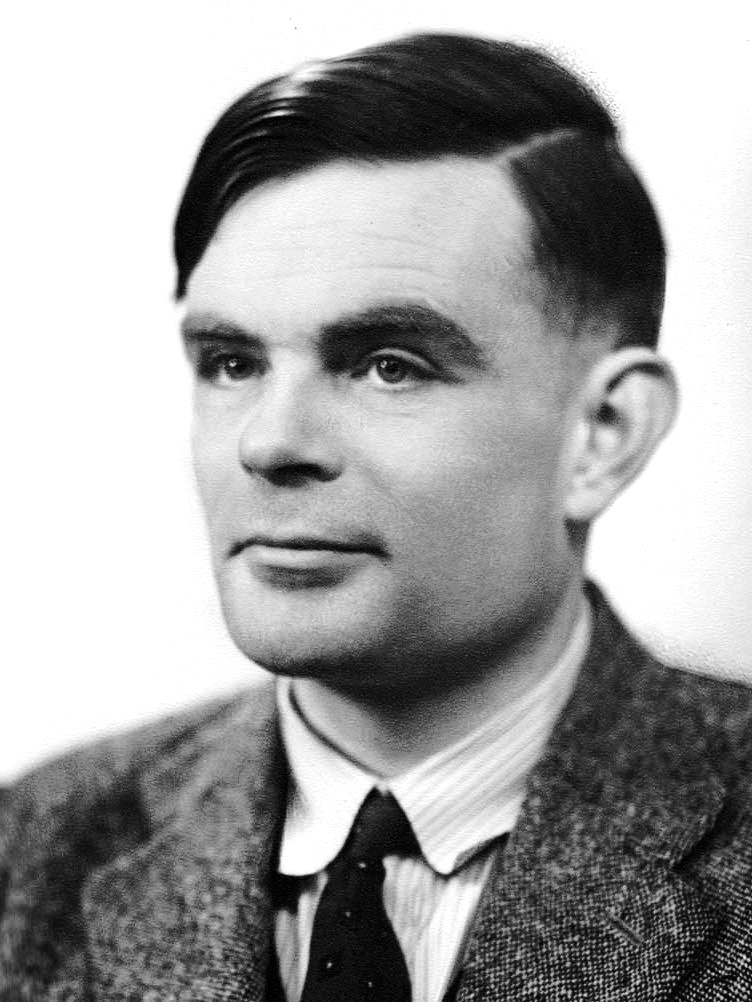
Alan Mathison Turing (1912–1954) is widely regarded as one of the most important figures in the history of science and technology. A mathematician, logician, cryptanalyst, and visionary thinker, Turing laid the theoretical foundations of computer science, played a decisive role in the Allied victory during the Second World War, and raised profound questions about intelligence, consciousness, and what it means to think. Despite his immense contributions, his life was marked by personal tragedy, social injustice, and a legacy that continues to provoke reflection on both scientific progress and human values.
Early Life and Education
Alan Turing was born on 23 June 1912 in London, England, to Julius Mathison Turing, a civil servant in the Indian Civil Service, and Ethel Sara Turing. Much of his early childhood was spent separated from his parents, who worked in India, a circumstance that contributed to his introspective and independent nature.
From an early age, Turing showed an intense curiosity about numbers, patterns, and how things worked. He demonstrated remarkable originality rather than conventional academic discipline, often approaching problems in unconventional ways. At Sherborne School, a prestigious public school, his talents were not always appreciated; the school emphasized classical education over science, and Turing was sometimes viewed as eccentric or socially awkward.
A pivotal influence on Turing’s intellectual and emotional development was his close friendship with Christopher Morcom, a fellow student with a shared passion for science. Morcom’s sudden death in 1930 deeply affected Turing and strengthened his interest in the nature of mind, matter, and whether human consciousness could be explained mechanistically. These questions would later resurface in his work on artificial intelligence.
Turing went on to study mathematics at King’s College, Cambridge, where his exceptional ability quickly became apparent. He was elected a Fellow of King’s College in 1935 for his work in probability theory. He later pursued doctoral studies at Princeton University under the logician Alonzo Church, further developing his ideas on computation and logic.
The Turing Machine and the Foundations of Computing
In 1936, Turing published one of the most influential papers in the history of mathematics and computer science: On Computable Numbers, with an Application to the Entscheidungsproblem. In this paper, he introduced the abstract concept now known as the Turing machine.
A Turing machine is a simple theoretical device consisting of an infinite tape, a read-write head, and a set of rules that determine its actions. Despite its simplicity, Turing showed that such a machine could perform any computation that could be described algorithmically. This idea provided a precise definition of computation itself and demonstrated the limits of what machines—and by implication, humans—could compute.
Turing’s work independently complemented that of Alonzo Church, whose lambda calculus addressed similar problems. Together, their conclusions led to what is now called the Church–Turing thesis: the proposition that any effectively calculable function can be computed by a Turing machine. This concept remains foundational to theoretical computer science.
Equally significant was Turing’s idea of the universal machine, capable of simulating any other Turing machine. This concept directly anticipates the modern programmable computer, in which a single device can perform many tasks depending on the program it runs.
Codebreaking and World War II
Turing’s theoretical brilliance found urgent practical application during the Second World War. In 1939, he joined the Government Code and Cypher School at Bletchley Park, Britain’s secret codebreaking center. There, he became a leading figure in the effort to break encrypted communications produced by the German Enigma machine.
The Enigma cipher was considered unbreakable due to the astronomical number of possible settings it could generate. Turing played a central role in developing electromechanical devices known as Bombes, which dramatically reduced the time required to find Enigma keys. His work enabled the Allies to read vast quantities of German military communications, providing critical intelligence that influenced the outcome of the Battle of the Atlantic and other major campaigns.
It is widely estimated that the codebreaking efforts at Bletchley Park shortened the war by at least two years, saving millions of lives. Yet for decades, Turing’s wartime contributions remained secret due to official classification.
Postwar Computing and Artificial Intelligence
After the war, Turing turned his attention to the development of actual computing machines. At the National Physical Laboratory, he worked on the design of the Automatic Computing Engine (ACE), one of the earliest proposals for a stored-program computer. Although bureaucratic delays meant that the full ACE was not completed as originally envisioned, its design influenced later British computers.
Turing later joined the University of Manchester, where he worked on software for one of the world’s first electronic computers. He was deeply interested not only in computation but in the possibility that machines might one day exhibit intelligent behavior.
In 1950, Turing published Computing Machinery and Intelligence, a paper that asked the now-famous question: “Can machines think?” Rather than attempting to define thinking, Turing proposed an operational test, later called the Turing Test. If a machine could engage in a conversation indistinguishable from that of a human, it could reasonably be considered intelligent.
This paper laid the philosophical foundations of artificial intelligence and continues to influence debates about machine learning, consciousness, and human–machine interaction.
Morphogenesis and Later Scientific Work
In the final years of his life, Turing turned to mathematical biology, exploring how patterns such as stripes on animals or the arrangement of leaves could arise from simple chemical processes. His 1952 paper on morphogenesis proposed reaction–diffusion models that demonstrated how complex natural patterns could emerge from basic physical laws.
This work was far ahead of its time and is now regarded as foundational in theoretical biology and the study of complex systems.
Persecution and Personal Tragedy
Despite his immense service to Britain, Turing’s life took a tragic turn in 1952 when he was prosecuted for homosexuality, which was then illegal in the United Kingdom. He was convicted of “gross indecency” and given a choice between imprisonment and chemical castration. He chose the latter, undergoing hormonal treatment that caused severe physical and psychological side effects.
As a result of his conviction, Turing lost his security clearance and was barred from further cryptographic work. The combination of public humiliation, professional exclusion, and personal isolation took a heavy toll.
On 7 June 1954, Alan Turing died from cyanide poisoning at the age of 41. His death was ruled a suicide, though some debate remains. Regardless of the circumstances, his life was cut tragically short.
Recognition and Legacy
For many years after his death, Turing’s achievements were insufficiently recognized. Gradually, as wartime secrecy lifted and social attitudes changed, his importance became widely acknowledged. In 2009, the British government issued a formal apology for his treatment, and in 2013 he was granted a posthumous royal pardon. In 2021, his image appeared on the £50 banknote, symbolizing his central place in British scientific history.
Alan Turing’s legacy is immense. He is a founding figure of computer science, a pioneer of artificial intelligence, a wartime hero, and a symbol of the human cost of intolerance. Modern computers, algorithms, and intelligent systems all trace their conceptual roots back to his ideas.
Beyond his technical contributions, Turing’s life raises enduring ethical and philosophical questions about how societies treat their most creative minds, how difference is perceived, and how progress should be measured—not only in technological terms, but in humanity and justice.
Alan Turing was not only a genius who helped build the modern world; he was also a man whose life reminds us that intellectual brilliance must be matched by moral responsibility. His work continues to shape the future, and his story continues to challenge us to do better.
