
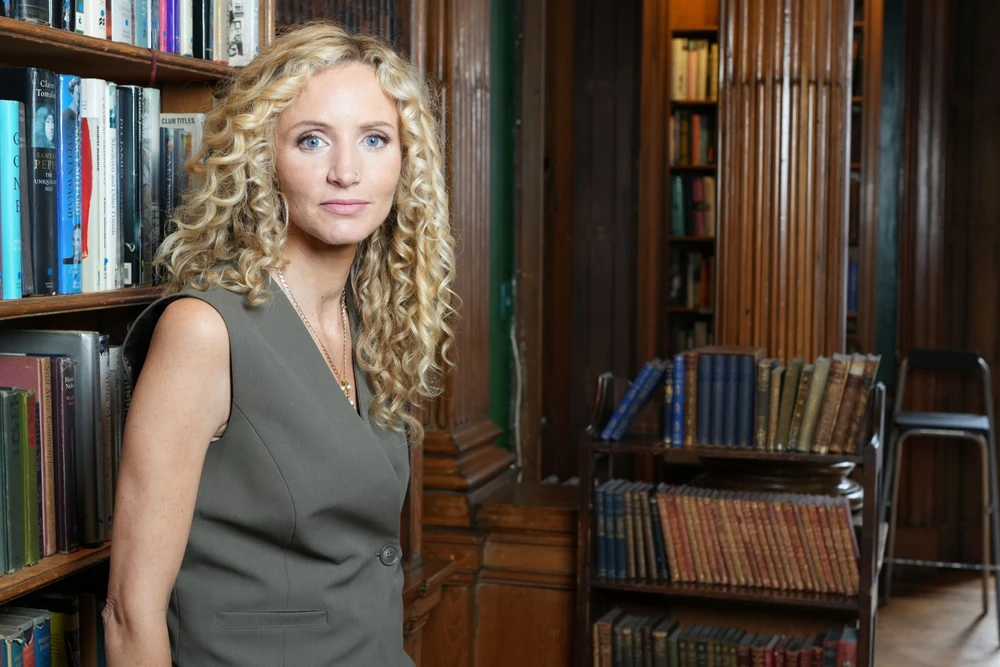
Professor Suzannah Lipscomb is one of Britain’s most respected and influential historians, particularly renowned for her work on Tudor and early modern history. As an academic, author, and broadcaster, she has played a significant role in reshaping popular understanding of the 16th century, challenging long-standing myths and simplistic narratives about figures such as Henry VIII and his queens. Lipscomb’s work is distinguished by its rigorous scholarship, clarity of communication, and commitment to restoring complexity and humanity to the past.
In a media landscape often dominated by sensationalised or personality-driven history, Suzannah Lipscomb stands out as a historian who insists on evidence, nuance, and historical context—while still making history engaging and accessible to a wide audience.
Early Life and Education
Suzannah Lipscomb was born in 1978 in England. She developed an early interest in history, particularly in the lives of people who lived outside the centres of power—women, families, and communities whose experiences were often overlooked in traditional historical narratives. This interest would later shape her academic focus and public work.
She studied history at Balliol College, Oxford, where she gained a strong grounding in historical methodology and critical analysis. She then went on to complete her doctoral research at the University of London, specialising in early modern England. Her academic training emphasised the importance of archival research, close reading of primary sources, and sensitivity to historical context—principles that continue to underpin her work.
Academic Career and Research Focus
Suzannah Lipscomb is a Professor of Early Modern History at the University of Roehampton. Her academic research focuses primarily on 16th-century England, with particular attention to social history, gender, marriage, and religion. Rather than concentrating solely on monarchs and political elites, Lipscomb explores how ordinary people lived, loved, married, and navigated social expectations.
One of her most significant scholarly contributions is her work on marriage and sexual relationships in early modern England. Her research challenges the assumption that Tudor society was uniformly repressive or morally rigid. By examining court records, letters, and ecclesiastical documents, Lipscomb reveals a more complex social reality—one in which relationships were negotiated, norms were contested, and lived experience often differed from official doctrine.
This emphasis on lived experience is central to Lipscomb’s historical philosophy. She consistently argues that the past should not be treated as a caricature of cruelty or ignorance, but as a world inhabited by real people making sense of their circumstances.
Writing and Major Publications
Lipscomb has written extensively for both academic and popular audiences. Her books are characterised by meticulous research combined with accessible prose, making them suitable for students, general readers, and history enthusiasts alike.
One of her most well-known works is 1536: The Year That Changed Henry VIII, which examines a pivotal year in Tudor history. Rather than offering a broad biography of Henry VIII, Lipscomb focuses on a single year marked by rebellion, political instability, and personal tragedy. This approach allows her to explore how events unfolded in real time, revealing uncertainty and contingency rather than inevitability.
She has also written extensively on the wives of Henry VIII, particularly Anne Boleyn and Catherine Howard. Lipscomb is notable for resisting simplistic portrayals of these women as either villains or victims. Instead, she situates them within the social, political, and gendered constraints of their time, restoring agency without ignoring vulnerability.
Her writing consistently challenges popular myths, including the idea of Henry VIII as a uniquely monstrous figure or Tudor England as exceptionally brutal by historical standards. Lipscomb does not excuse cruelty or injustice, but she insists on comparative and contextual analysis.
Broadcasting and Public History
Suzannah Lipscomb is a familiar face on British television, appearing in numerous documentaries on the BBC, Channel 4, and other broadcasters. She has presented series such as A Very British Sex Scandal and Hidden Killers of the Tudor Home, and has been a frequent expert contributor on programmes exploring Tudor politics, religion, and domestic life.
What distinguishes Lipscomb as a broadcaster is her ability to communicate complex ideas clearly without oversimplification. She speaks with precision, avoids speculation unsupported by evidence, and is careful to distinguish between historical fact and later interpretation.
Her television work often focuses on the everyday realities of the past—health, hygiene, marriage, childbirth, and domestic labour. By exploring these themes, Lipscomb helps viewers understand history not just as a sequence of events, but as a lived human experience.
Challenging Tudor Myths and Popular Misconceptions
One of Lipscomb’s most important contributions to public history is her challenge to entrenched Tudor myths. Popular culture often portrays Tudor England as uniquely violent, oppressive, and backward, populated by tyrants and victims. Lipscomb argues that such portrayals distort historical understanding and obscure meaningful comparison.
For example, she has repeatedly questioned the portrayal of Henry VIII as a singularly cruel ruler, noting that while his actions were often ruthless, they were not unprecedented in early modern Europe. By placing Henry within broader political and religious contexts, she encourages audiences to move beyond moral judgement toward historical explanation.
Similarly, Lipscomb challenges the sexualised and sensational portrayals of Tudor women, particularly Catherine Howard. She has argued that modern interpretations often project contemporary assumptions onto the past, failing to account for differences in age, consent, and power dynamics.
Gender, Feminism, and Historical Responsibility
Suzannah Lipscomb is often associated with feminist history, though she resists simplistic labels. Her work undeniably foregrounds women’s experiences and challenges male-dominated narratives, but she is careful not to impose modern ideologies on historical subjects.
Instead, Lipscomb advocates for what might be called historically grounded feminism: an approach that seeks to recover women’s voices and agency while acknowledging the constraints of their time. She has been critical of portrayals that turn historical women into either modern feminist icons or passive victims, arguing that both approaches flatten complexity.
Her work highlights how gender shaped opportunity, vulnerability, and power in early modern England, without assuming that women’s lives were uniformly bleak or devoid of meaning.
Teaching and Mentorship
In addition to her public work, Lipscomb is deeply committed to teaching. As a university professor, she is known for engaging students with primary sources and encouraging critical thinking rather than rote learning. She emphasises historical skills—analysis, contextualisation, and argument—over memorisation of dates and names.
She has also been involved in historical education beyond the university, contributing to public lectures, festivals, and outreach programmes. This reflects her belief that history should not be confined to academia, but shared widely and responsibly.
Criticism and Academic Integrity
As a prominent public historian, Lipscomb has occasionally faced criticism, particularly from those who prefer more sensational or simplified narratives. Some critics argue that her emphasis on nuance reduces drama or emotional impact. Lipscomb’s response has been consistent: accuracy matters more than entertainment.
She has also been vocal about the responsibilities of historians in public life, particularly in resisting misinformation and historical distortion. In an era of online myth-making and politicised history, Lipscomb advocates for evidence-based interpretation and intellectual honesty.
Legacy and Influence
Suzannah Lipscomb’s influence lies in her ability to bridge academic history and popular understanding without compromising either. She has helped elevate public expectations of historical programming, demonstrating that audiences are capable of engaging with complexity and uncertainty.
Her work has influenced how Tudor history is taught, discussed, and portrayed, particularly in relation to women and social life. She has also helped normalise the presence of academically rigorous historians—especially women—in mainstream media.
Conclusion
Suzannah Lipscomb represents the best of modern public history: rigorous, empathetic, and intellectually responsible. Through her research, writing, and broadcasting, she has challenged myths, restored complexity, and brought the lived experiences of the Tudor past into sharper focus.
In doing so, she reminds us that history is not about heroes and villains, but about people navigating the possibilities and limits of their world. Lipscomb’s work encourages us not simply to judge the past, but to understand it—and through that understanding, to think more carefully about our own present.
