
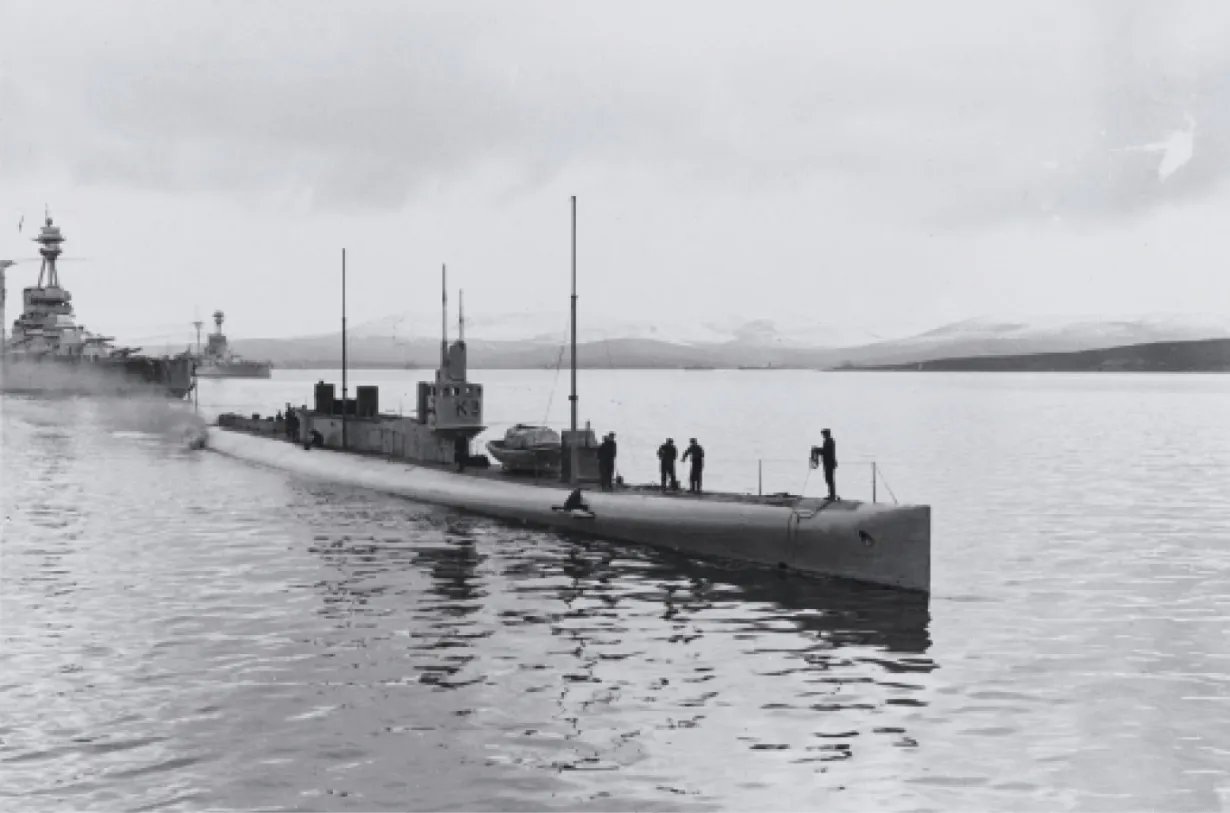
The K-class submarines were one of the most ambitious—and controversial—naval engineering projects ever undertaken by the Royal Navy. Developed during the First World War, they were designed to operate alongside the battle fleet, combining the stealth of submarines with the speed of surface warships. However, despite their innovative design, they became infamous for technical flaws, operational difficulties, and a series of tragic accidents.
Origins and Strategic Concept
At the beginning of the 20th century, submarines were relatively slow vessels. Typical submarines could travel at around 10 knots on the surface and even slower when submerged. This made them unsuitable for operating with the Royal Navy’s fast-moving battle fleet, which could exceed 20 knots.
The Royal Navy’s solution was radical: create a “fleet submarine” capable of matching the speed of battleships. This concept emerged during the early years of the World War I, when naval planners sought ways to integrate submarines into large-scale fleet actions.
The result was the K-class—submarines powered not only by electric motors underwater but by steam turbines on the surface. This decision would define both their strengths and their failures.
Design and Engineering
Steam-Powered Submarines
The defining feature of the K-class was its propulsion system. Unlike conventional submarines that used diesel engines, the K-class used:
- Oil-fired boilers
- Steam turbines
- Electric motors for submerged operation
This allowed them to reach speeds of up to 24 knots on the surface, making them among the fastest submarines ever built at the time.
However, this design introduced enormous complexity. Before diving, the crew had to:
- Shut down the boilers
- Vent steam
- Retract funnels
- Seal numerous openings
This process could take several minutes—far too long in combat situations.
Size and Layout
The K-class submarines were significantly larger than most submarines of their era:
- Length: approximately 339 feet (103 metres)
- Displacement: over 2,500 tons (surfaced)
- Crew: around 59 personnel
Their large size was necessary to accommodate the steam machinery, but it also made them less manoeuvrable and harder to control, especially in confined waters.
Internally, conditions were extremely challenging. The presence of boilers meant:
- High temperatures
- Steam leaks
- Condensation issues
Crew members often worked in uncomfortable and dangerous conditions.
Armament
The K-class submarines were heavily armed for their time, reflecting their intended role in fleet combat:
- Ten 18-inch torpedo tubes
- Deck guns (typically 4-inch)
- Some units were later equipped with additional weaponry
Their armament made them formidable on paper, capable of delivering significant damage to enemy ships.
Innovative Features
Despite their problems, the K-class incorporated several forward-thinking ideas:
1. High-Speed Fleet Integration
They were designed to operate directly with battleships, a concept that influenced later submarine development.
2. Advanced Navigation Systems
Because they were expected to operate in formation, they required improved navigation and signalling systems.
3. Early Snorkel Experiments
Some K-class submarines experimented with early forms of snorkel systems, although these were not fully developed.
Operational History
Construction and Deployment
A total of 18 K-class submarines were built between 1915 and 1918. They were constructed rapidly due to wartime urgency, which contributed to design flaws and inconsistencies.
They were assigned to the Grand Fleet, based primarily at Scapa Flow in Scotland.
Performance in Service
In practice, the K-class submarines struggled to fulfil their intended role. Key issues included:
- Slow diving times
- Mechanical unreliability
- Poor handling characteristics
Their large size and turning radius made them difficult to operate in formation with other ships, especially at night or in poor visibility.
The “Battle of May Island”
The most infamous episode involving the K-class submarines occurred on the night of 31 January 1918, in an घटना often referred to as the Battle of May Island.
Despite the name, this was not a battle with enemy forces, but a series of catastrophic collisions involving Royal Navy vessels.
What Happened?
A large fleet exercise was underway in the Firth of Forth. Due to:
- Poor visibility
- Communication failures
- The complexity of manoeuvring large formations
Several ships collided, including multiple K-class submarines.
Consequences
The حادث resulted in:
- Two K-class submarines sunk (K4 and K17)
- Over 100 sailors killed
- Several other vessels damaged
The disaster was kept secret for many years due to wartime censorship.
Lessons Learned
The Battle of May Island highlighted:
- The dangers of operating submarines in close formation
- The limitations of existing navigation and communication systems
- The inherent risks of the K-class design
Technical Problems and Failures
Diving Difficulties
One of the most serious flaws of the K-class was its inability to dive quickly. The need to shut down steam systems meant that:
- Emergency dives were difficult
- The submarines were vulnerable to attack
Mechanical Issues
The steam propulsion system was prone to:
- Leaks
- Equipment failures
- Maintenance difficulties
Saltwater ingress into boilers could cause catastrophic damage.
Safety Hazards
The combination of steam and submarine operation created numerous hazards:
- Risk of explosions
- Burns from high-pressure steam
- Flooding through poorly sealed openings
These issues contributed to the submarines’ poor reputation among crews.
Maintenance Challenges
Maintaining the K-class submarines was a major undertaking.
Complexity of Systems
The dual propulsion system required:
- Specialist engineers
- Frequent maintenance
- Extensive inspections
This made them more resource-intensive than conventional submarines.
Wear and Tear
The harsh operating environment led to rapid wear of components, including:
- Boilers
- Turbines
- Hull structures
Logistical Burden
Supporting K-class submarines required significant infrastructure, including:
- Dockyard facilities
- Spare parts supply chains
- Skilled personnel
Decline and Withdrawal
By the end of the First World War, it was clear that the K-class submarines were not a success.
Several factors led to their early retirement:
- Advances in diesel-electric submarine technology
- Recognition of design flaws
- High operational risk
Most K-class submarines were scrapped during the early 1920s.
Legacy and Impact
Despite their failures, the K-class submarines had a lasting impact on naval engineering.
Lessons for Submarine Design
They demonstrated the importance of:
- Simplicity and reliability
- Fast diving capability
- Safe and manageable propulsion systems
Influence on Future Submarines
Later submarine designs avoided steam propulsion entirely, favouring:
- Diesel-electric systems
- Eventually nuclear propulsion
Engineering Innovation
The K-class pushed the boundaries of what was technically possible at the time. While the results were flawed, the project contributed to:
- Advances in marine engineering
- Better understanding of submarine operations
Conclusion
The K-class submarines stand as a fascinating example of ambitious engineering meeting harsh reality. Designed to revolutionise naval warfare, they instead became a cautionary tale about overcomplication and the risks of untested innovation.
Their story is one of bold ideas, technical challenges, and human cost. While they failed in their primary mission, they provided valuable lessons that shaped the future of submarine design.
Today, the K-class is remembered not just for its مشکلات and disasters, but for its role in the evolution of naval engineering—an experiment that, despite its shortcomings, helped pave the way for more successful submarine technologies in the years that followed.
