
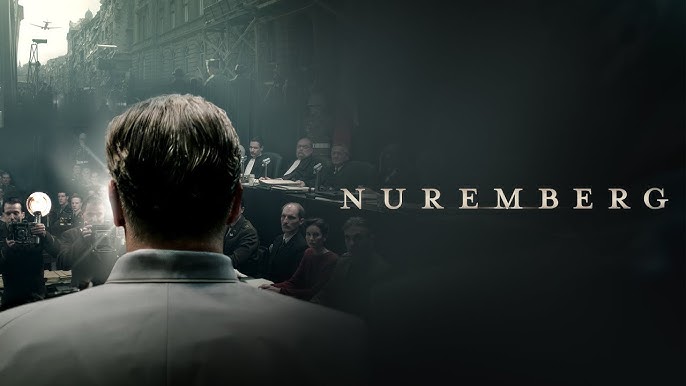
The 2025 film Nuremberg, written and directed by James Vanderbilt, is a historical-psychological drama that revisits the landmark post-World War II war-crimes trials of top-ranking Nazi officials. It is inspired by the 2013 non-fiction book The Nazi and the Psychiatrist by Jack El‑Hai, and features a stellar cast including Russell Crowe as Nazi leader Hermann Göring and Rami Malek as U.S. Army psychiatrist Douglas Kelley.
Below is a detailed overview of the film: its context and background, narrative and themes, key performances and direction, critical reception, and its relevance today.
1. Historical & Production Context
The film is set in the immediate aftermath of WWII, focusing on how the Allied powers attempted to hold Nazi leadership accountable through the so-called Nuremberg Trials. The screenplay and direction by James Vanderbilt aim to explore not just the legal proceedings but also the psychological dimension of these captives.
Production details:
- Filming took place in Budapest, Hungary, from February to May 2024.
- It had its world premiere at the Toronto International Film Festival (TIFF) on September 7, 2025, where it reportedly received a four-minute standing ovation.
- The film was released theatrically in the U.S. on November 7, 2025, and in the U.K. on November 14, 2025.
In making Nuremberg, Vanderbilt sought to mark the 80th anniversary of the trials, giving the story renewed urgency.
2. Narrative & Themes
At its core, Nuremberg focuses on the interplay between psychiatrist Douglas Kelley and Hermann Göring, set against the backdrop of the Nazi surrender, the establishment of the tribunal, and the psychological evaluations of Nazi leaders.
Key narrative beats include:
- The film opens around the time of Göring’s surrender and sets the stage for the Allied march toward justice.
- Kelley is assigned to determine whether Göring and other Nazi defendants are mentally fit to stand trial, whether they might commit suicide before trial, and to catalogue their statements.
- A major moment: the tribunal screens actual footage of Nazi camps, jolting the courtroom and pushing the film’s moral dimension into focus.
Themes
- Justice vs. vengeance: The film asks whether the trials were purely about justice or also about retribution and establishing moral order. Vanderbilt himself remarked that it explores “the fragile boundary between justice and vengeance.”
- Psychology of evil: Through the Kelley-Göring dynamic, the film probes what motivates individuals who carry out such atrocities — is it madness, ideology, ambition, rational choice? Kelley’s real-life conclusion was that many of the Nazi defendants were neither psychotic nor insane, but opportunistic, which shifts the blame squarely onto agency.
- Memory, responsibility, and warning to posterity: The film isn’t only about past events but also a reminder of what happens when societies allow hate, propaganda, and authoritarianism to rise. One character says: “It happened here because the people made it happen, because they didn’t stand up until it was too late.”
- Media and spectacle of justice: The trials were, in part, a stage for global morality; the film depicts how the courtroom became a kind of theater for international law and public memory.
3. Performances & Direction
Russell Crowe as Hermann Göring
Crowe’s portrayal of Göring stands out. Critics widely note his performance as chilling, charismatic, and commanding. He reportedly learned German phrases and embodied Göring’s manipulative charm.
Rami Malek as Douglas Kelley
Malek plays the American psychiatrist grappling with the moral enormity of what he witnesses and the challenge of maintaining his professional detachment. The film frames Kelley as both investigator and existential witness.
Supporting Cast & Direction
The ensemble includes Michael Shannon (as U.S. prosecutor Robert H. Jackson), Richard E. Grant (British counsel David Maxwell Fyfe), Leo Woodall, John Slattery and others. Vanderbilt’s direction is noted for its polished look, dark atmospheric tones, and tight sound design — yet critics say its pacing is uneven.
4. Critical Reception
The critical reception has been mixed to moderately positive.
- On Rotten Tomatoes the film holds a score around 73 % (based on ~59 reviews) with the summary: “Driven by a commanding performance from Russell Crowe, Nuremberg is a handsomely crafted historical drama, but its measured pacing and emotional restraint keep it from fully realizing the complexity of its subject.”
- Some critics suggest that despite strong performances and visual ambition, the film doesn’t fully deliver in terms of narrative depth or emotional engagement. For example: “It’s a solid film … but at 2h20 it can’t deal with every issue it raises (such as the fragility of the psychiatrist’s confidentiality oath).”
“The pacing is uncalibrated, the scope too scattered … still: the human and the historian in me feel compelled to recommend it.”
While the film earned a rousing response at festivals, some early reviews were less enthusiastic, noting that its courtroom and psychological drama approach may feel more conventional than groundbreaking.
5. Significance & Relevance
Why does Nuremberg matter?
- Historical education: For many audiences, the Nuremberg Trials are familiar in name but not fully understood in detail. This film brings to life not just the legal process but the psychological and moral dimensions of post-war justice.
- Contemporary resonance: The film resonates in a world where questions of atrocity, accountability, war crimes, and collective responsibility are again prominent. The lessons about complacency and the emergence of authoritarianism are timely.
- Cinematic revisit of WWII aftermath: Many WWII films focus on combat or liberation; Nuremberg shifts focus to what comes after: the reckoning, the law, and the human cost of trying to process genocide and mass crimes. As Vanderbilt noted, “there have been a lot of World War II movies but there haven’t been a lot of post-World War II movies.”
- Performance vehicle: The film gives Crowe and Malek intense material. Crowe’s turn as Göring could position him for awards consideration and provides an actor-driven anchor for the story.
- Moral complexity: By focusing on Kelley’s medical/psychiatric role rather than simply the courtroom theatrics, the film asks uncomfortable questions: what does justice mean? What is accountability? Can evil be “understood”? What happens to those who survive the system?
6. Strengths & Weaknesses
Strengths
- Strong lead performances, particularly Crowe as Göring and Malek as Kelley.
- High production values: period sets, cinematography, sound, and archival footage weaving in real material.
- Thought-provoking themes about psychology, justice, responsibility.
- Fresh perspective on a familiar subject matter (the Nuremberg Trials) by focusing on the psychiatrist’s lens.
Weaknesses
- Some reviewers feel the pacing is slow, the film tries to cover too much ground in 148 minutes (2h28).
- Because of its broad scope, many characters and subplots (other defendants, legal details, international politics) receive only surface treatment.
- The emotional connection may feel muted for some viewers — the emphasis is on process and psychology rather than high-drama catharsis.
- For those familiar with the historical period, the film may not reveal significantly new insights — it’s more about dramatization than deep academic historiography.
7. Final Thoughts
Nuremberg is a compelling, if somewhat restrained, addition to the genre of WWII and post-war cinema. It may not reach the emotional heights of some great wartime epics, but its ambition to explore the intersection of law, psychology and atrocity gives it depth. If you’re interested in the mechanics of justice after mass-crimes, or the portrayal of how societies confront their darkest chapters, this film is worth your time.
The film resonates especially given current global context: movements for justice, war-crimes tribunals, and the risk of history repeating itself when societies fail to remain vigilant. The interplay between Kelley and Göring becomes more than a historical curiosity — it is a mirror. As one character in the film puts it, the key question isn’t just whether these men stood trial, but whether we will stand up if the conditions repeat.
