
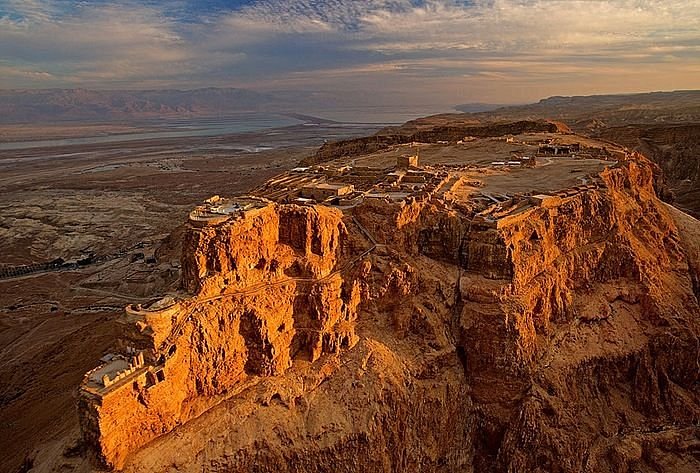
Visiting Masada on a day trip while working on a kibbutz in Israel was one of those experiences where history, landscape, and personal reflection collided in a way that lingered long after the day itself had ended. It was not just an excursion to an ancient site, but a journey into the layered identity of the land — a place where stories of endurance, survival, and moral complexity are etched into the very rock.
Leaving the Kibbutz
Life on the kibbutz had its own rhythm. Days were defined by early starts, shared work, communal meals, and conversations that stretched late into the evening. There was a strong sense of collective purpose, but also a growing curiosity among us about the country beyond the fields and orchards we worked in. Masada had been spoken about often — not casually, but with a tone of reverence.
Setting out early in the morning, we boarded a bus that cut through the changing landscape of southern Israel. The greenery surrounding the kibbutz gradually gave way to harsher, more arid terrain. Fields thinned, colours faded, and the land opened up into wide, exposed spaces. The air grew drier, the sky larger. Even before Masada came into view, the journey itself felt like a transition — from everyday routine to something ancient and monumental.
First Sight of Masada
Masada rises abruptly from the desert floor, an isolated plateau crowned with ruins that seem almost defiant in their placement. From a distance, it appears both imposing and improbable — a fortress carved into stone, surrounded by emptiness. Seeing it for the first time, I understood immediately why it held such symbolic weight.
The contrast between the calm desert below and the sheer cliffs of the plateau was striking. There was an immediate sense that this was not simply a historical site, but a place where geography itself had shaped history.
Ascending the Mountain
We chose to ascend using the Snake Path, the ancient trail that winds its way up the side of the mountain. The climb was slow and deliberate, particularly under the rising heat. Each step demanded attention. The path twisted back on itself, revealing new angles of the desert below with every turn.
As we climbed, conversation faded. The effort required, combined with the silence of the desert, encouraged introspection. The only sounds were footsteps on stone, the occasional gust of wind, and the steady rhythm of breathing. It felt appropriate — a quiet approach to a place defined by solemn history.
Looking out over the Dead Sea in the distance, its surface shimmering faintly, I felt the scale of the landscape. This was not a backdrop; it was an active participant in the story of Masada.
On the Plateau
Reaching the top was both physically and emotionally impactful. The plateau opened up into a sprawling complex of ruins — remnants of palaces, storage rooms, bathhouses, and defensive walls. The layout revealed a sophisticated settlement, carefully designed to sustain life in an unforgiving environment.
Walking among the ruins, I was struck by the ingenuity of those who had lived here. Advanced water systems, cisterns carved into rock, and carefully planned structures spoke of a society that understood both its limitations and its strengths. Masada was not merely a refuge; it was a statement of resilience.
The Weight of History
Masada is inseparable from its story — the final stand of Jewish rebels against Roman forces in the first century CE. Our guide spoke carefully, acknowledging both the historical record and the symbolic interpretations that have evolved over time.
Standing there, it was impossible not to feel the emotional gravity of the place. The vast Roman siege ramps were still visible, etched into the surrounding slopes. The scale of the effort required to conquer this isolated fortress was staggering.
Yet Masada is not a simple story of heroism or tragedy. It is complex, layered, and deeply human. Being there encouraged reflection rather than judgement. It asked questions without offering easy answers.
Views Over the Desert
From the edge of the plateau, the view was breathtaking. The Judean Desert stretched endlessly, its subtle colours shifting with the light. The Dead Sea lay far below, serene and silent. The height and isolation made the world beyond feel distant, almost unreal.
The wind carried heat and dust, but also a strange sense of clarity. There was space here — physical and mental. Space to think, to absorb, to reflect on how place shapes identity and memory.
Personal Reflection
Visiting Masada while working on a kibbutz added another layer to the experience. The kibbutz represented collective living, shared responsibility, and modern expressions of community. Masada, in contrast, represented isolation, endurance, and ancient struggle.
The juxtaposition was powerful. One reflected the present and future; the other, the deep past. Together, they framed a broader understanding of Israeli identity — rooted in survival, shaped by land, and constantly evolving.
Descending and Returning
The descent felt quieter still. The heat intensified, and fatigue settled into muscles, but there was also a sense of completion. The desert below seemed less empty now, filled with context and meaning.
Returning to the kibbutz later that day, the normal rhythms resumed — work, meals, conversation. Yet the experience of Masada lingered. It coloured how I saw the land around me, adding depth to places I had previously viewed as merely functional or scenic.
Lasting Impressions
Masada is not a place you visit casually. It demands effort, attention, and emotional engagement. It does not entertain; it challenges. It reminds you that history is not abstract, but grounded in real landscapes and real choices made by real people.
For me, the day trip from the kibbutz to Masada became one of the most memorable experiences of my time in Israel. It was a moment where work, travel, history, and personal reflection converged into something enduring.
Conclusion
Visiting Masada was not about ticking off a famous site. It was about standing in a place where human resilience and moral complexity are permanently inscribed into stone. It was about understanding how landscape and history shape identity, and how the past continues to inform the present.
Long after leaving Israel, the image of Masada rising from the desert remains vivid — a reminder of endurance, reflection, and the power of place.
