
Arriving in Edinburgh in winter always feels like stepping into a city that knows exactly who it is. The dark stone buildings, the narrow streets, and the ever-present sense of history seem to lean into the season rather than fight it. In the days after Christmas, the city felt calmer but no less atmospheric, with festive lights still glowing against the stone while winter’s cold air sharpened every sound and movement. I had come primarily to visit the Christmas Market, but as is often the case with Edinburgh, the city had other plans.
From Waverley Station, I headed uphill toward the Royal Mile, the historic heart of the Old Town and one of the most famous streets in Scotland. Stretching from Edinburgh Castle at its highest point down to the Palace of Holyroodhouse, the Royal Mile has been the city’s main thoroughfare for centuries. Kings, queens, merchants, soldiers, reformers, and ordinary citizens have all passed along this same route, and walking it today still carries a sense of that accumulated past.
The Royal Mile isn’t just one street but a sequence of streets—Castlehill, Lawnmarket, High Street, and Canongate—each reflecting a different chapter of Edinburgh’s history. Tall tenements rise on either side, built upward rather than outward in medieval times when space within the city walls was limited. Narrow closes open off the main road, some leading to hidden courtyards, others plunging steeply downhill. These passageways once echoed with daily life, but also with disease, crime, and political unrest. Edinburgh was overcrowded, unsanitary, and intensely alive.
Dominating everything is Edinburgh Castle, perched high on Castle Rock, the remains of an extinct volcano. The site has been occupied for thousands of years and has served as a royal residence, military fortress, and national symbol. From almost anywhere in the city, the castle is visible, a constant reminder of power, conflict, and continuity. Even standing below it on the Royal Mile, you feel its presence pressing down, shaping the city around it.
While still making my way along the Royal Mile, I realised I had time before my walking tour, which I had booked online earlier that morning. I decided to wander, take in the street, and observe the mix of locals and visitors already filling the pavements. Street performers were setting up, shops were opening their doors, and the city felt as though it was slowly stretching itself awake.
Finding the tour, however, turned out to be less straightforward than expected. As the start time approached, I headed toward the meeting point, only to find what felt like every walking tour in Edinburgh gathered on the same stretch of street. Guides held umbrellas, flags, or signs, calling out in different languages. What stood out immediately was the sheer number of Spanish-language tours. At one point it felt like half the Royal Mile was being addressed in Spanish, and I briefly wondered whether Spanish tour companies had quietly taken over the city.
Despite having the meeting point details, I still found myself weaving between groups, trying to work out which one was mine. Eventually, with only minutes to spare, I located the correct tour near St Giles’ Cathedral. It turned out that my tour was also run by a Spanish company, though conducted in English—a detail I hadn’t noticed when booking. Relief set in just as the guide began to speak.
The tour took us through some of the most significant sites on the Royal Mile. St Giles’ Cathedral, often called the High Kirk of Edinburgh, is one of the city’s most important religious buildings. Founded in the 12th century, it became closely associated with John Knox, the central figure of the Scottish Reformation. Knox served as minister here in the 16th century, preaching against Catholicism and shaping Scotland’s move toward Presbyterianism. His influence on Scottish religious and political life was profound, and standing outside the cathedral, it’s impossible not to feel the weight of that history.
Nearby stands the Mercat Cross, historically the centre of civic life in Edinburgh. This was where markets were held, royal proclamations announced, and punishments carried out. Although the current structure dates from the 19th century, it marks a tradition that stretches back hundreds of years. It’s one of those places where the everyday and the monumental intersect—a reminder that history isn’t just made in palaces and castles, but in public squares and streets.
Although the tour didn’t include entry into Edinburgh Castle itself, we spent time in the forecourt just outside the gates, where the views across the city were still impressive. From this elevated position, Princes Street stretched out below, with Princes Street Gardens forming a green ribbon through the centre of the city and the ordered layout of the New Town rising beyond. On a clear day, it’s even possible to make out the Forth bridges in the distance, linking Edinburgh to the wider landscape beyond. Standing there, just outside the castle walls, it was easy to understand why this site was chosen in the first place—high, defensible, and commanding views in every direction, reinforcing its long-standing strategic and symbolic importance.
Unfortunately, it was here that my time with the tour came to an abrupt and unintended end. Leaving the castle, I took a right turn down a set of stone steps, convinced I had seen the guide go that way. I even spotted a couple from the group stopping to take photographs, which reassured me. But by the time I reached the bottom, emerging into the Grassmarket, the rest of the group had vanished.
I waited for a while, scanning the area, checking my phone, hoping they would appear. They didn’t. The tour was nearing its end anyway—there was likely only one stop left—but I still felt slightly guilty. I had planned to tip the guide, and losing the group felt like an awkward, unfinished ending. Still, there was little to be done, and Edinburgh was waiting.
From the Grassmarket, I wandered on alone and soon found myself at the bottom of Victoria Street. Curving uphill in a colourful sweep of shops and cafés, it’s one of the most photographed streets in the city. A large queue stretched outside a Harry Potter shop, a reminder of how closely Edinburgh is associated with J.K. Rowling and the world she created. The street buzzed with energy, and it felt like a place where history and modern tourism collided in a very visible way.
From there, I made my way toward Calton Hill, one of Edinburgh’s most distinctive landmarks. The climb is short but steep, and as I reached the top, the wind made its presence known. The cold was biting, but the view more than compensated. Calton Hill offers sweeping panoramas across the city, from the Old Town to the New Town and beyond to the Firth of Forth.
What makes Calton Hill especially striking is its collection of monuments, which give it an almost ancient, classical atmosphere. The most prominent is the National Monument of Scotland, inspired by the Parthenon in Athens. Intended as a memorial to Scottish soldiers who died in the Napoleonic Wars, it was never completed due to lack of funds. Often referred to as “Edinburgh’s Disgrace,” it now feels more like a romantic ruin—unfinished, but powerful.
Nearby stands the Dugald Stewart Monument, a circular structure dedicated to the Enlightenment philosopher Dugald Stewart. Positioned perfectly against the skyline, it has become one of the city’s most iconic viewpoints. Also on the hill is the City Observatory, reflecting Edinburgh’s long-standing connection to science, astronomy, and intellectual life. Together, these monuments reinforce the city’s reputation during the Enlightenment as the “Athens of the North.”
While sitting at the top, taking in the view, I was joined by a young Chinese student who asked if it was okay to sit nearby. We soon struck up a conversation, initially about photography, and then about our backgrounds. He told me he was studying at Middlesbrough University, working on a film production linked to his studies from a university in China. I mentioned that I had recently completed a foundation course in creating a music video, and we quickly realised we had a lot in common.
It was one of those unexpected travel encounters that stay with you—not because they’re dramatic, but because they’re quietly human. Two strangers, from different parts of the world, sitting on a cold hilltop in Edinburgh, talking about creativity and shared interests. Despite the cold, there were many tourists on Calton Hill, all drawn by the same view and atmosphere.
Eventually, the cold became too much. My hands were numb from exposure to the wind, and it was time to seek warmth. I made my way to Café Calton, grateful for a hot coffee and a chance to sit indoors. I checked the time; the light was fading, and it was nearly time to head to the Christmas Market, the main reason for my visit.
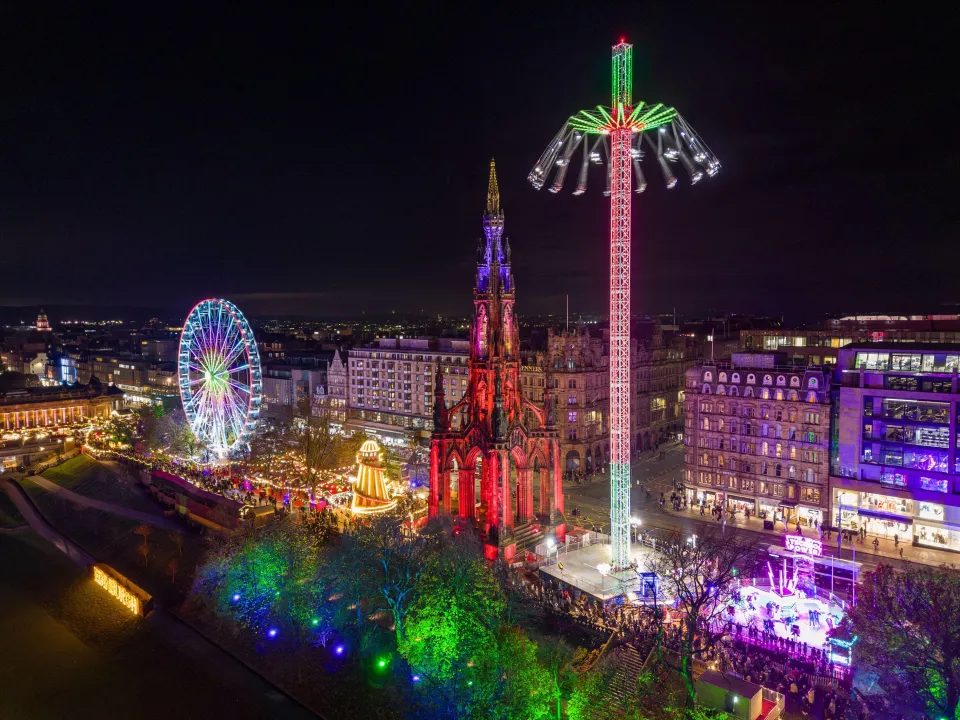
As darkness settled, I walked toward Princes Street Gardens, where the Edinburgh Christmas Market transforms the space each year. The gardens themselves have an interesting past. Once the site of the polluted Nor Loch, they were redeveloped in the 19th century after the construction of the New Town. Today, they form a green corridor between the Old and New Towns, with Edinburgh Castle rising dramatically above them.
At Christmas, the gardens are filled with light, sound, and movement. Wooden chalets lined the pathways, selling everything from handcrafted gifts and festive decorations to woollen scarves, candles, and ornaments. The smell of food hung in the air—mulled wine, roasted chestnuts, sausages, waffles, and sweet treats—creating a comforting contrast to the cold.
The fairground rides added another layer of energy. Music played, lights flashed, and the sound of laughter echoed through the gardens. Families queued for rides, couples wandered hand in hand, and groups of friends gathered around food stalls, cups of mulled wine in hand. The Ferris wheel was the centrepiece, slowly turning against the night sky, its lights reflected in the surrounding windows.
I wandered through the market at an unhurried pace, taking in the atmosphere and watching the rides in motion. There’s something timeless about a fairground in winter—bright lights cutting through darkness, a sense of shared enjoyment, and the simple pleasure of warmth and food on a cold night.
Before leaving, I made my way up to Princes Street to view the market from the shops opposite. From there, the Ferris wheel stood out even more clearly, framed by the historic buildings and the illuminated castle beyond. Fighting against the flow of shoppers, I paused to take it all in: the lights below, the movement of the crowd, and the unmistakable sense of a city celebrating the season.
Eventually, it was time to head back. As I walked away from the market and toward the station, the sounds faded behind me, replaced by the familiar rhythm of footsteps and winter air. It had been a full day—one shaped as much by history and place as by chance encounters and small misadventures.
Edinburgh at Christmas isn’t just about markets and decorations. It’s about walking through centuries, getting slightly lost, meeting strangers, and finding warmth—both literal and human—along the way. It’s a city that rewards wandering, and even when plans don’t quite go as expected, it has a way of giving you exactly the day you didn’t know you needed.
