
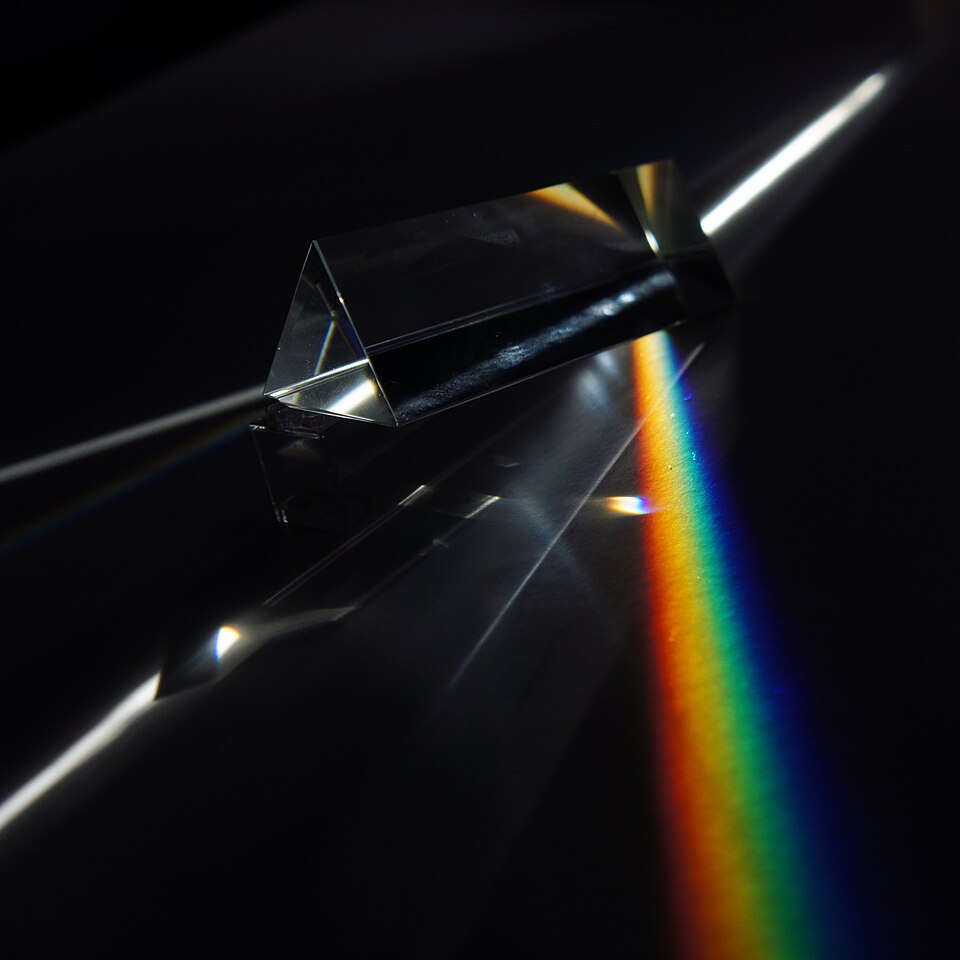
Light is one of the most fundamental phenomena in the universe. It allows us to see the world around us, carries energy from the Sun to the Earth, and plays a crucial role in technologies ranging from microscopes and telescopes to fibre-optic communications and lasers. Despite its everyday familiarity, the way light travels is both fascinating and complex, involving principles from classical physics, electromagnetism, and quantum mechanics. Understanding how light travels has been one of the central challenges in physics, shaping our knowledge of nature itself.
What Is Light?
At its most basic level, light is a form of energy known as electromagnetic radiation. It consists of oscillating electric and magnetic fields that propagate through space. Light does not require a material medium to travel, which distinguishes it from mechanical waves such as sound, which require air, water, or another substance.
Light occupies a small portion of the electromagnetic spectrum, which includes radio waves, microwaves, infrared radiation, visible light, ultraviolet radiation, X-rays, and gamma rays. Visible light is the part of the spectrum that the human eye can detect, with wavelengths ranging approximately from 400 nanometres (violet) to 700 nanometres (red).
Early Ideas About Light Travel
Historically, scientists debated whether light travelled instantaneously or had a finite speed. Ancient Greek philosophers such as Aristotle believed that light travelled instantly. It was not until the 17th century that evidence emerged suggesting otherwise.
In 1676, the Danish astronomer Ole Rømer made the first quantitative estimate of the speed of light by observing the moons of Jupiter. He noticed discrepancies in the timing of eclipses depending on the relative positions of Earth and Jupiter, concluding that light took time to travel across space. This discovery was revolutionary, demonstrating that light has a finite speed.
Today, the speed of light in a vacuum is known to be approximately 299,792,458 metres per second, commonly rounded to 3 × 10⁸ m/s. This value is so fundamental that it is used to define the metre itself.
Light as a Wave
One of the most important ways to understand how light travels is through the wave model. In the 19th century, experiments by scientists such as Thomas Young and Augustin-Jean Fresnel demonstrated that light exhibits wave-like behaviour.
Wave Propagation
As a wave, light travels by the continuous oscillation of electric and magnetic fields perpendicular to the direction of travel. These fields regenerate each other as the wave moves forward, allowing light to propagate through empty space.
Key wave properties of light include:
- Wavelength: the distance between successive wave peaks
- Frequency: the number of oscillations per second
- Amplitude: related to the intensity or brightness of the light
The relationship between wavelength, frequency, and speed is given by:
speed = wavelength × frequency
Since the speed of light in a vacuum is constant, changes in wavelength are accompanied by corresponding changes in frequency.
Reflection and Refraction
The wave nature of light explains many everyday phenomena. When light strikes a surface and bounces back, this is known as reflection. Smooth surfaces, such as mirrors, reflect light in a predictable way, producing clear images.
When light passes from one medium to another (for example, from air into water or glass), it changes speed and direction. This bending of light is called refraction. Refraction occurs because light travels more slowly in materials than in a vacuum. This explains why a straw appears bent in a glass of water and why lenses can focus light.
Light as a Particle
Although the wave model explains many properties of light, it cannot explain all observed phenomena. In the early 20th century, experiments such as the photoelectric effect revealed that light also behaves like a particle.
Albert Einstein proposed that light consists of discrete packets of energy called photons. Each photon carries an amount of energy proportional to the frequency of the light.
This particle-like behaviour is crucial for understanding how light interacts with matter, such as:
- How solar panels generate electricity
- How digital cameras detect images
- How lasers produce highly focused beams of light
Wave–Particle Duality
Modern physics recognises that light exhibits wave–particle duality. This means that light cannot be fully described as either a wave or a particle; instead, it displays properties of both depending on how it is observed or measured.
When light travels through space, it behaves predominantly like a wave. When it interacts with matter, such as being absorbed or emitted by atoms, it behaves like a particle. This dual nature is a fundamental principle of quantum mechanics and challenges our everyday intuition.
How Light Travels Through Different Media
While light travels at its maximum speed in a vacuum, it slows down when passing through materials such as air, water, or glass. This reduction in speed occurs because light interacts with the atoms in the medium.
When a photon enters a material, it is repeatedly absorbed and re-emitted by atoms. Although each individual interaction happens very quickly, the cumulative effect causes the overall speed of light in the material to be lower than in a vacuum.
The ratio between the speed of light in a vacuum and its speed in a material is known as the refractive index. Materials with higher refractive indices bend light more strongly, which is why diamonds sparkle so intensely.
Straight-Line Travel of Light
In a uniform medium, light travels in straight lines. This principle, known as rectilinear propagation, explains why shadows form and why we cannot see around corners under normal conditions.
However, light can appear to bend or spread out due to:
- Diffraction, where light spreads when passing through a narrow opening
- Scattering, where light is redirected by particles in the atmosphere
Scattering is responsible for the blue colour of the sky and the red hues of sunsets and sunrises.
Light in Space and Relativity
In Einstein’s theory of special relativity, the speed of light in a vacuum is the same for all observers, regardless of their motion. This remarkable fact has profound consequences for our understanding of space and time.
Because the speed of light is constant:
- Time can slow down for fast-moving objects (time dilation)
- Lengths can contract at high speeds
- Mass and energy are related through the famous equation E = mc²
Light also plays a key role in general relativity, where gravity is described as the curvature of spacetime. Massive objects such as stars and galaxies can bend the path of light, an effect known as gravitational lensing, which allows astronomers to study distant objects in the universe.
Light in Modern Technology
Understanding how light travels has led to countless technological advancements. Fibre-optic cables use total internal reflection to guide light over long distances with minimal loss, forming the backbone of modern internet and telecommunications systems.
Lasers rely on the controlled emission of photons to produce intense, coherent beams of light used in medicine, manufacturing, scientific research, and consumer electronics.
Even everyday devices such as barcode scanners, LED lighting, and optical sensors depend on precise control of how light travels and interacts with matter.
Conclusion
The way light travels is far more complex and intriguing than it may first appear. From its incredible speed and ability to travel through empty space to its dual nature as both a wave and a particle, light challenges and expands our understanding of physics. Its behaviour underpins not only our ability to see but also some of the most advanced technologies and deepest scientific theories ever developed.
By studying how light travels, scientists have unlocked insights into the structure of atoms, the nature of spacetime, and the vast scale of the universe itself. Light is not just a tool for observation—it is a fundamental messenger of the laws of nature, connecting the smallest particles to the largest cosmic structures.
