
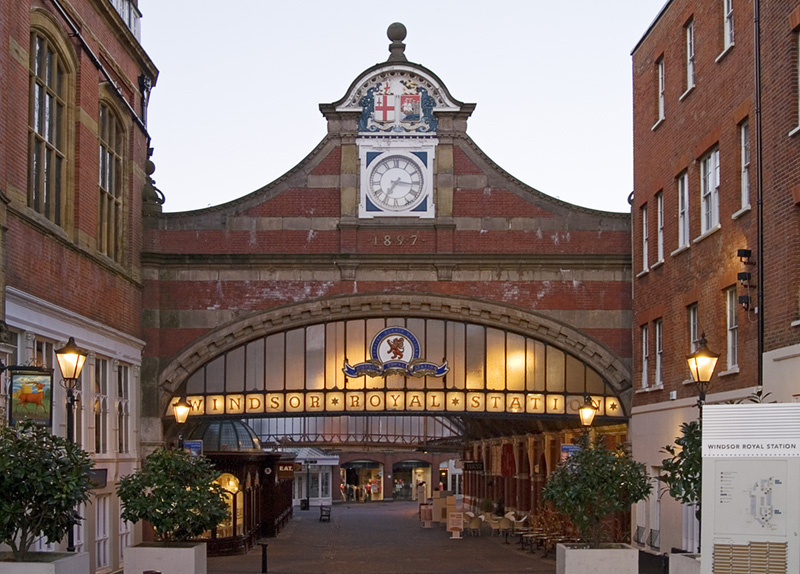
Windsor Royal Station stands today as a unique fusion of Victorian railway heritage and modern retail culture in the heart of Windsor, Berkshire, England. Just opposite Windsor Castle — one of the United Kingdom’s most emblematic royal residences — this Grade II listed building carries a remarkable story that spans nearly two centuries of transport history, royal associations, architectural significance, commercial regeneration, and cultural adaptation.
Originally constructed as a railway station, it now forms the core of Windsor Royal Shopping — a vibrant hub of boutiques, cafés, restaurants, and amenities that attract both visitors to Windsor and local residents alike. But beneath its present‑day commercial façade lies a rich narrative of Victorian ambition, royal travel, architectural grandeur, and adaptive reuse that encapsulates broader themes in British heritage conservation.
Origins: Railways Meet Royalty
The story of Windsor Royal Station begins in the mid‑19th century, a period when the coming of the railways was transforming British towns, economies, and social life. Windsor’s proximity to London and its royal significance made it a particularly desirable destination for a railway connection.
The first railway station in Windsor opened on 8 October 1849, when the Great Western Railway (GWR) completed a branch line from Slough to Windsor. This new link meant that the town — long serviced solely by horse and carriage — now enjoyed fast, convenient access to the capital. Trains could reach Windsor from London in a matter of minutes, transforming travel for both residents and visitors.
The advent of the railway was not without controversy. Local institutions such as Eton College initially resisted the idea, worried that the proximity of a railway might disrupt student life and introduce unwelcome influences. Nevertheless, the railway prevailed, and Windsor’s transport history was profoundly altered.
Victorian Expansion and Architectural Grandeur
The original 1849 station underwent a dramatic rebuild between 1890 and 1897 under the auspices of the Great Western Railway. This development coincided with Queen Victoria’s Diamond Jubilee in 1897, and the station’s redesign was intended in part to provide a suitably grand gateway for royal and public rail travel.
The resulting building was far more than a functional terminus. Its ornate arched entrance — known now as the Jubilee Arch — brickwork, and elegant ironwork reflected the Victorian railway era’s confidence and ambition. Large glazed roofs supported on decorative iron columns elevated the station’s interior, creating light‑filled spaces with a sense of breath and openness reminiscent of major urban termini.
Key features of the historic structure included:
- The Jubilee Arch, the formal entrance which remains a defining landmark at Thames Street opposite Windsor Castle.
- Queen Victoria’s Royal Waiting Room, a preserved relic of the station’s exclusive royal use, where the monarch and her household could await trains with privacy and dignity.
- Victorian architectural details, such as historic ticket stands, original interior fittings, and segmental roof forms that underline the building’s heritage value.
This design ensured that the station’s presence matched Windsor’s historic and ceremonial importance, particularly as one end of rail journeys that might begin or end near Windsor Castle’s ancient gates.
Royal Connections and Historical Moments
Rail travel was embraced by the royal family almost from its inception. Queen Victoria herself frequently used the station, travelling between Windsor and London on state and private business. Her presence helped cement the station’s association with royal travel — an identity reflected not just in the grand architectural style but in the very positioning of the building near the Castle’s main entrance.
The station’s history also includes darker moments. In March 1882, an attempted assassination of Queen Victoria occurred as she was departing from the station — an incident that reverberated socially and legally, influencing how mentally ill offenders were treated in the British justice system.
Mid‑Century Decline and Transformation
By the late 20th century, rail travel patterns and infrastructure demands had changed dramatically. Most of the Windsor & Eton Central station complex was no longer required for active rail use. Passenger services had diminished in extent, leaving only a truncated portion of Platform 1 in regular use for the short shuttle service between Windsor and Slough.
Rather than allowing the grand station buildings to decay, planners and developers saw an opportunity for adaptive reuse. Starting in the 1990s, significant efforts were made to convert the historic station structure into a retail and leisure hub, while preserving as many historic features as possible.
The project won acclaim for its sensitive restoration, which retained original cobbled stones, ironwork, arches, and the much‑loved Royal Waiting Room. The former goods yard now hosts a terrace of boutique shops, designed to echo the decorative screen wall that once separated the station’s commercial operations from the royal route leading to Windsor Castle.
This repurposing is a prime example of how heritage buildings can be given new life without erasing their past, ensuring that architecture continues to be both relevant and vibrant.
Windsor Royal Shopping: A Modern Destination
Today, Windsor Royal Station forms the heart of Windsor Royal Shopping — a distinctive retail and dining destination that combines historic atmosphere with contemporary amenities. Situated directly opposite Windsor Castle, it benefits from more than 7 million tourist visits per year, a testament to both its location and appeal.
The centre includes over 40 boutique shops, restaurants, cafés, and bars under elegant glass‑arched roofs and restored Victorian brickwork. Boutique fashion brands, artisan gift shops, tea houses, and specialist retailers mix with well‑known names, offering a retail experience that feels more curated and atmospheric than typical high‑street malls.
Notable features include:
- Boutique and specialist retail, from high‑end clothing to gourmet food and unique souvenirs.
- Restaurant and café culture, making the space a destination for meals as well as shopping.
- A historic ambience where Victorian architectural elements remain visible within the contemporary interior.
Visitors often describe Windsor Royal as a place where history isn’t hidden behind glass, but woven naturally into the experience — from original brickwork to the sweeping vaulted ceilings that recall a bygone era of steam and ceremony.
Heritage Status and Future Plans
As a Grade II listed building, Windsor Royal Station is legally protected due to its architectural and historic importance. This status ensures that any future alterations must respect the integrity of the original Victorian design and its significant features.
Recent planning applications highlight ongoing efforts to restore and preserve elements like the Jubilee Arch and roof structures, reflecting a desire to maintain the building’s historic character while enhancing its commercial viability.
Community Role and Cultural Identity
Windsor Royal Station today is more than a shopping centre; it’s a cultural anchor in Windsor’s town centre. It provides:
- A welcoming space for tourists visiting Windsor Castle and other local attractions.
- A place for community gathering, dining, and leisure.
- A visual reminder of the era when rail travel was transforming Britain.
What makes Windsor Royal particularly fascinating is how it bridges eras: the Victorian era’s optimism in rail and engineering on one hand, and the 21st‑century emphasis on heritage‑led regeneration on the other.
Conclusion
Windsor Royal Station is a rare example of a historic railway building that has been reimagined rather than replaced. Its evolution — from a royal‑serving terminus to a community‑serving commercial hub — speaks to the adaptability of heritage architecture when quality conservation meets creative vision.
Whether you’re a rail enthusiast intrigued by Victorian design, a history lover drawn by royal associations, or a visitor looking for a distinctive shopping and dining experience, Windsor Royal Station offers a unique blend of past and present. Located in the shadow of one of Britain’s greatest landmarks — Windsor Castle — it continues to welcome travellers and residents alike, proving that history can live on not just in textbooks or museums, but in the daily rhythms of town life.
