
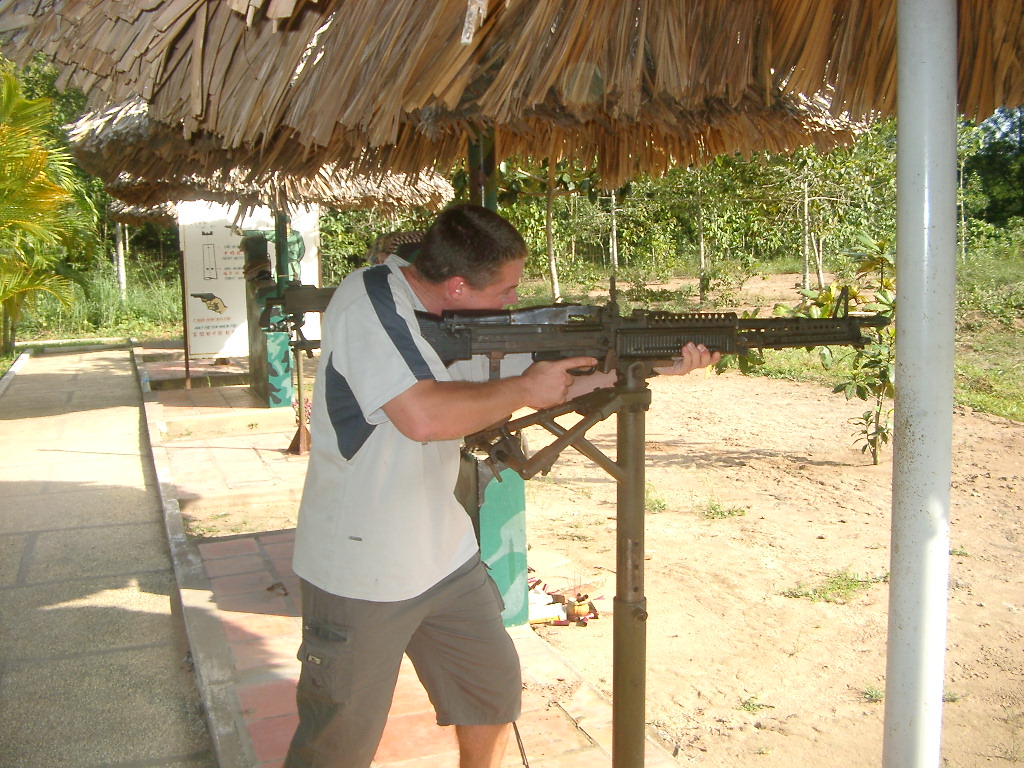
Visiting the Củ Chi Tunnels in Vietnam is not a typical tourist experience. It is not just a place you see; it is a place you feel. Located outside Ho Chi Minh City, the tunnel complex is deeply rooted in the history of the Vietnam War and serves as a stark reminder of the ingenuity, resilience, and hardship endured by the Vietnamese people. Walking through this environment already carries emotional weight, but the experience took on an entirely different dimension when I took part in fire practice firing an M60 machine gun — an activity that was both thrilling and sobering.
What made the experience so powerful was not just the act of firing a weapon, but the context in which it occurred. This was not a shooting range detached from history. This was a landscape shaped by conflict, survival, and resistance.
Arriving at the Củ Chi Tunnels
The journey to the Củ Chi Tunnels itself sets the tone. Leaving the busy streets of Ho Chi Minh City, the scenery gradually changes to rural landscapes — fields, trees, and quiet villages. It is difficult to imagine that beneath this calm exterior lies an intricate underground network that once housed thousands of fighters, families, and support systems during the war.
Upon arrival, the atmosphere felt subdued and respectful. Our guide began by explaining the significance of the tunnels: how they stretched for hundreds of kilometres, contained living quarters, kitchens, hospitals, command centres, and escape routes, and how they allowed Vietnamese fighters to survive relentless bombing and superior military technology.
Walking through the area, seeing disguised trapdoors, narrow tunnel entrances, and reconstructed living spaces, I gained an appreciation for the conditions people endured. The tunnels were claustrophobic, dark, and unforgiving. Even enlarged sections designed for tourists were uncomfortable, making it almost impossible to imagine spending days or weeks underground.
The Weight of History
Before any talk of weapons, the history took centre stage. The guide spoke about daily life in the tunnels — the lack of food, the constant threat of detection, the ingenuity required to survive. Every detail added gravity to the visit. This was not a place of glorification; it was a place of remembrance.
Understanding this context made everything else feel heavier. The soil beneath my feet had absorbed decades of struggle. The trees above had once concealed entrances and absorbed the shockwaves of bombing. It was clear that any activity involving weapons here could never be just entertainment.
Approaching the Firing Range
The firing range at Củ Chi is set away from the main tunnel areas, but the sound of gunfire carries across the site. Even from a distance, the deep, rhythmic thudding of heavy weapons is unmistakable. Hearing it echo through the forest adds an unsettling realism to the experience — a reminder that these sounds were once part of daily life here.
When the opportunity to fire an M60 machine gun was presented, I felt conflicted. On one hand, there was curiosity — a chance to handle a piece of history, to understand the sheer physicality of a weapon that had played such a significant role in warfare. On the other hand, there was awareness: this weapon had been designed to kill, and firing it in a place like this carried weight.
Ultimately, I chose to proceed, not as a thrill-seeker, but as someone wanting to understand the experience more deeply.
First Impressions of the M60
The M60 is an imposing weapon. Even before firing it, the weight is immediately apparent. It feels solid, industrial, unapologetically functional. Holding it, I became acutely aware of how different this was from anything recreational or abstract. This was not a symbolic artefact behind glass; it was a real, operational machine.
The instructor explained the basics: stance, grip, recoil management, and safety. Even with hearing protection, the anticipation of firing such a powerful weapon was intense. The M60 is not subtle. It does not whisper; it announces itself.
Pulling the Trigger
The moment I fired the M60 is etched in my memory. The recoil was immediate and forceful, a deep, physical sensation that travelled through my arms and torso. The sound was overwhelming — a thunderous roar that seemed to vibrate through the ground itself.
Each burst felt like a controlled explosion. The weapon demanded respect; it could not be handled casually. I had to focus completely on maintaining control, on keeping the weapon steady, on responding to its power rather than fighting it.
What struck me most was how impersonal it felt. The rounds disappeared downrange almost instantly, a reminder of how quickly damage can be inflicted. There was no sense of precision or finesse — just raw force.
Emotional Contrast
Despite the adrenaline, there was no sense of triumph. Instead, I felt reflective. Standing there, surrounded by jungle that had once been a battlefield, I was acutely aware of the contrast between my controlled, brief firing session and the reality of combat.
For soldiers and fighters, weapons like the M60 were not experiences; they were necessities. They were tools used under extreme stress, fear, and uncertainty. Firing the weapon for a few seconds gave me a tiny glimpse into the physical demands of operating such machinery, but it could never replicate the psychological weight carried by those who used it in war.
Sound and Sensation
Even with ear protection, the sound lingered. The echo of gunfire reverberated through the trees, reminding me how noise itself can be a weapon — disorienting, overwhelming, relentless. I imagined what it must have been like to hear this constantly, day after day, without choice.
The smell of gunpowder hung in the air, sharp and unmistakable. It added another layer of sensory realism, grounding the experience in something raw and tangible.
Stepping Back
After firing the M60, I stepped away from the range and allowed the moment to settle. The adrenaline faded quickly, replaced by contemplation. I looked around at the surrounding forest, at the quiet that returned once the firing stopped, and thought about how temporary silence must have been during the war.
The contrast between peace and violence felt stark. One moment, the jungle was alive with sound and force; the next, it was calm again. That contrast alone made the experience meaningful.
Reflection on the Experience
Firing an M60 at the Củ Chi Tunnels was not something I walked away from feeling proud or excited about. Instead, I walked away feeling thoughtful. The experience deepened my understanding of the physical reality of warfare — the weight, noise, and sheer force involved.
It also reinforced the importance of context. Without the history of Củ Chi, firing a weapon could easily become a novelty. But here, surrounded by reminders of struggle and survival, it became something else entirely: a moment of reflection on power, responsibility, and the human cost of conflict.
The Bigger Picture
The Củ Chi Tunnels are a testament to resilience and ingenuity, not violence. They represent survival against overwhelming odds, adaptation in the face of adversity, and the determination of people defending their homeland. Experiencing the tunnels, crawling through sections, seeing hidden entrances and traps, and then firing an M60 created a powerful contrast between defensive ingenuity and industrial firepower.
That contrast is what stayed with me most.
