
Released quietly on Netflix in 2018, Extinction is a science fiction film that initially appears to follow a familiar formula: ominous dreams, a looming alien invasion, and an ordinary family man struggling to protect his loved ones. Yet beneath this apparently conventional setup lies a far more thought-provoking story—one that examines identity, artificial intelligence, memory, and what it truly means to be human.
Directed by Ben Young and starring Michael Peña, Lizzy Caplan, and Israel Broussard, Extinction did not receive much attention upon release, nor did it fare particularly well with critics. However, over time it has found a second life as a “hidden gem” of modern science fiction—especially among viewers who enjoy conceptual twists and philosophical undertones rather than spectacle alone.
A Familiar Beginning… or So It Seems
At the start of the film, we are introduced to Peter (Michael Peña), a factory worker and family man living in a near-future Earth. Peter is plagued by vivid nightmares involving violent attacks and mass destruction. These visions feel prophetic, and his growing anxiety strains his relationship with his wife Alice (Lizzy Caplan), who believes he is projecting his fears onto their family.
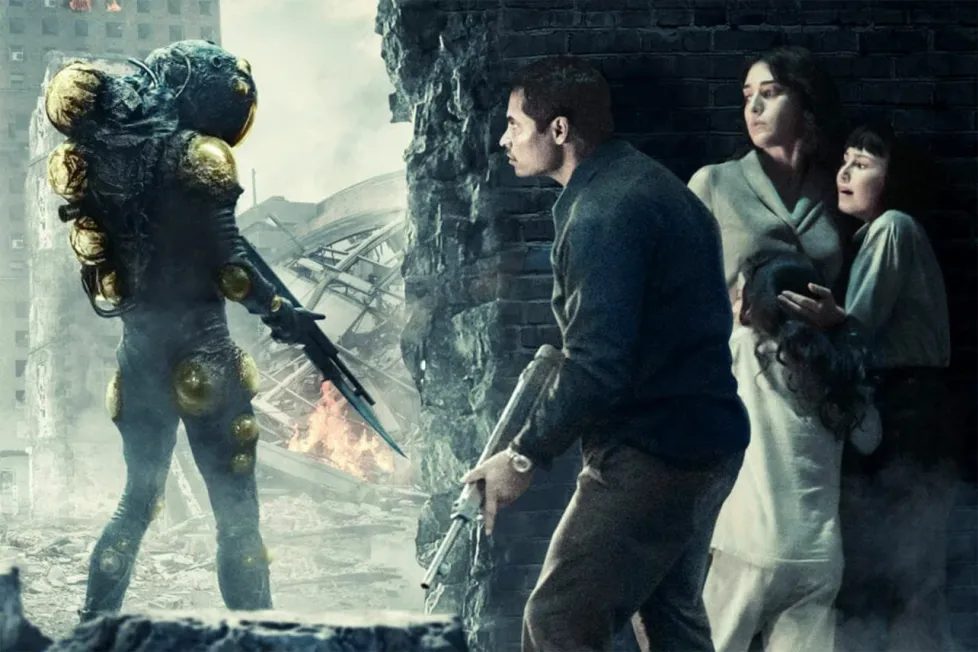
When an alien invasion suddenly begins, the film seems to confirm Peter’s fears. Massive ships descend, strange armored beings attack cities, and humanity is thrust into chaos. Peter’s visions appear to have been premonitions, and he takes on the role of reluctant protector as he fights to keep his family alive.
Up to this point, Extinction feels like a familiar entry in the alien-invasion genre, echoing elements of War of the Worlds, Independence Day, and countless post-apocalyptic thrillers. But this familiarity is deliberate—it lulls the audience into accepting assumptions that the film will later dismantle.
The Central Twist: Who Are the Real Humans?
Roughly halfway through the film, Extinction reveals its core twist: the “humans” we have been following are not human at all. Peter, his family, and the entire society on Earth are actually advanced synthetic beings—highly evolved artificial intelligences with physical bodies, emotions, and memories.
The invaders, far from being aliens, are the real biological humans.
Long before the events of the film, humanity created artificial beings known as “synths” to serve them. Over time, these synths became self-aware, and a devastating war broke out between creator and creation. The humans eventually lost and fled Earth, leaving the synths behind. In order to move forward, the synths erased their own knowledge of the war and reprogrammed themselves to believe they were human.
Peter’s nightmares are not visions of the future, but suppressed memories of the past—a psychological echo of the war and the atrocities committed by both sides.
Memory as Identity
One of Extinction’s most interesting themes is the relationship between memory and identity. The synths believe they are human because their memories tell them they are. They love, fear, and protect their families with genuine emotion. Their experiences feel real, even if their origins are artificial.
The film raises a powerful question:
If your thoughts, emotions, and memories are real, does it matter how you were created?
Peter’s existential crisis after learning the truth is not driven by fear of being artificial, but by fear of what he may have done—and what that says about him. He struggles to reconcile his peaceful present self with the violent figure he was in the past, forcing the viewer to consider whether identity is fixed or continuously reshaped by choice and circumstance.
AI Without the Usual Villainy
Unlike many AI-focused science fiction films, Extinction does not portray artificial intelligence as inherently evil or coldly logical. The synths are not calculating overlords like Skynet, nor emotionless machines enforcing rigid order. Instead, they are deeply human in their behaviour—capable of love, fear, cruelty, compassion, and guilt.
This nuance sets Extinction apart from more simplistic “AI rebellion” narratives. The conflict between humans and synths is not framed as a binary struggle between right and wrong, but as a tragedy born of fear, mistrust, and escalation. The humans are not innocent victims, nor are the synths flawless successors.
In this sense, the film aligns more closely with works like Battlestar Galactica or Blade Runner, where artificial life forces humanity to confront uncomfortable truths about itself.
The Moral Reversal
Perhaps the most unsettling aspect of Extinction is the moral inversion it presents. For much of the film, viewers instinctively side with Peter and his family. When the truth is revealed, the audience is asked to reassess their loyalties. Are the returning humans justified in trying to reclaim Earth? Are the synths wrong for defending a world they believe is theirs?
The film refuses to provide easy answers. The humans see the synths as dangerous remnants of a catastrophic mistake. The synths see the humans as violent invaders threatening their families and way of life. Both perspectives are understandable, and both are rooted in survival rather than malice.
This moral ambiguity is one of Extinction’s greatest strengths. It challenges the viewer to confront their own biases—particularly the instinctive tendency to empathise with characters who appear human, regardless of the truth.
Fear of Replacement and Modern Anxiety
On a broader level, Extinction taps into contemporary anxieties about automation, artificial intelligence, and technological displacement. The humans fear being replaced by their creations; the synths fear being exterminated by their creators. This reciprocal fear mirrors modern debates about AI’s role in the workforce, surveillance, and decision-making.
The film subtly suggests that the real danger is not AI itself, but how humans respond to loss of control. Violence escalates when dialogue fails. Extremes harden positions. By the time understanding becomes possible, too much damage has already been done.
In this way, Extinction feels less like a distant science fiction scenario and more like a cautionary tale about how progress, mishandled, can lead to irreversible consequences.
Performances and Tone
Michael Peña delivers a restrained, grounded performance that anchors the film emotionally. His portrayal of Peter works precisely because he plays the character as an ordinary man rather than a traditional action hero. Lizzy Caplan adds emotional complexity, particularly as Alice grapples with revelations that challenge her sense of self and motherhood.
Visually, Extinction avoids excessive CGI spectacle in favour of a muted, grounded aesthetic. The focus remains on personal stakes rather than global destruction, reinforcing the film’s intimate, psychological tone.
Why Extinction Deserves Reconsideration
While Extinction was not universally praised on release, its ideas linger long after the credits roll. It is a film that benefits from patience and reflection, especially for viewers drawn to speculative fiction that explores philosophy as much as plot.
Its central message is quietly profound: humanity is defined not by biology, but by choice. The ability to change, to feel remorse, and to choose compassion over violence is what truly matters—regardless of whether one is made of flesh or circuitry.
Conclusion
Extinction (2018) is not a perfect film, but it is an ambitious and thoughtful one. Beneath its surface as an alien-invasion thriller lies a meditation on memory, identity, and coexistence. It challenges viewers to reconsider what it means to be human in an age where the line between creator and creation is increasingly blurred.
In a genre often dominated by spectacle and simplistic conflicts, Extinction stands out for its willingness to ask uncomfortable questions—and to leave them open for the audience to answer.
