
Exploring the mesmerizing landscape of Devil’s Marbles, known to the Traditional Owners as Karlu Karlu, was far more than a roadside stop or a scenic detour—it was a journey into the ancient soul of Australia. Situated deep in the Northern Territory, hundreds of kilometres from any major city, this remarkable site felt like a threshold between the familiar world and something far older, quieter, and infinitely more powerful. From the moment I arrived, surrounded by countless granite boulders scattered across the red earth, I felt as though I had stepped into an otherworldly realm shaped by forces far beyond human comprehension.
The vastness of the Australian outback is difficult to describe to anyone who has not experienced it firsthand. The drive itself was an exercise in patience and contemplation. Long stretches of road disappeared into the horizon, bordered by spinifex grass and low scrub, with the sky stretching endlessly above. The sense of scale was overwhelming, and as the kilometres rolled by, modern life seemed to fall away. By the time Karlu Karlu came into view, the journey had already prepared me mentally for something extraordinary.
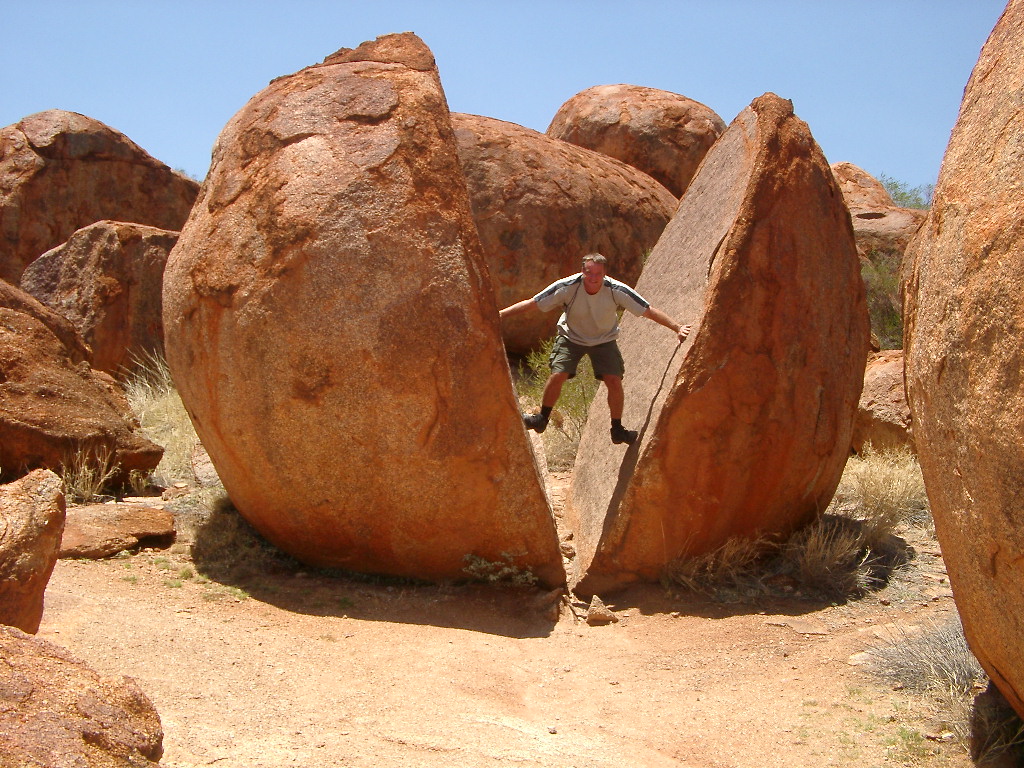
At first glance, the Devil’s Marbles appear almost surreal—giant spherical boulders seemingly placed at random across the landscape. Some balance precariously on top of one another, defying gravity in a way that makes you pause and question how they could possibly remain upright. Others are split cleanly in half, as if struck by an immense blade. The formations feel deliberate, almost sculpted, yet they are entirely natural, the result of millions of years of geological processes involving erosion, temperature changes, and time on a scale that the human mind struggles to grasp.
Walking among the boulders, I felt a profound sense of insignificance in the best possible way. These stones were ancient long before humans ever set foot on the continent. They had witnessed the rise and fall of climates, ecosystems, and cultures. Each step between them felt like moving through a gallery curated by nature itself, where every twist and turn revealed new shapes, shadows, and perspectives. No two boulders were the same. Some resembled animals, others faces, and some abstract forms that shifted depending on the angle of the light.
The silence was one of the most striking aspects of the experience. The outback has a particular kind of quiet—not the absence of sound, but a subtle stillness broken only by the whisper of wind, the rustle of grass, or the distant call of a bird. Standing alone among the marbles, I became acutely aware of my surroundings. The heat radiated from the rocks, the red dust clung to my boots, and the air carried the faint scent of earth and vegetation. It was a sensory experience that grounded me completely in the present moment.
As the day progressed, the changing light transformed the landscape. The granite boulders shifted in colour, moving from muted greys to warm oranges and deep reds. This transformation reached its peak during sunrise and sunset, when the marbles glowed as if lit from within. Watching the sun dip below the horizon, casting long shadows across the land, felt almost ceremonial. The sky exploded into hues of pink, purple, and gold, providing a dramatic backdrop to the silent stone giants. It was impossible not to feel a deep sense of awe.
Karlu Karlu holds profound spiritual significance for the Aboriginal people of the region, particularly the Warumungu, Kaytetye, Alyawarre, and Warlpiri peoples. According to traditional stories, the marbles are the eggs of the Rainbow Serpent, a powerful ancestral being central to many Aboriginal Dreamtime narratives. Knowing this added another layer of meaning to the experience. These were not merely geological curiosities but sacred objects embedded in a living cultural landscape that continues to hold deep meaning today.
With that knowledge, my wandering took on a more respectful and contemplative tone. I moved carefully, aware that this was not just a place to observe but a place to honour. Informational signs throughout the area helped explain the cultural importance of Karlu Karlu, reinforcing the idea that this landscape should be approached with humility. It served as a reminder that travel is not only about discovery but also about understanding and respect.
Time seemed to behave differently among the Devil’s Marbles. Without the distractions of technology, schedules, or noise, hours slipped by unnoticed. I found myself sitting quietly on the red earth, simply observing the way shadows moved across the stones, how light danced across their curved surfaces, and how the landscape seemed to breathe with the rhythm of the day. In those moments, the experience felt almost meditative—a rare opportunity to disconnect from the modern world and reconnect with something elemental.
The physicality of the environment also made itself known. The outback sun was relentless, and the heat demanded respect. Water was essential, and every movement was deliberate. Yet even the harshness of the environment added to its beauty. Life here survives against the odds, and the resilience of the land was palpable. Small plants clung stubbornly to the rocky soil, and insects buzzed quietly around the boulders, continuing their ancient routines unaffected by human presence.
As evening approached and the temperature began to cool, the atmosphere shifted once more. The sky darkened, revealing a canopy of stars unlike anything seen in urban environments. With little light pollution, the Milky Way stretched vividly across the sky, a reminder that this land exists not only in geological time but also under a cosmic scale. Standing beneath the stars, surrounded by stones shaped over millions of years, I felt deeply connected to both the Earth and the universe beyond it.
Leaving Karlu Karlu was unexpectedly difficult. There was a sense that I was departing from something sacred, something that had offered a quiet lesson without words. The Devil’s Marbles did not overwhelm with grandeur in the way mountains or waterfalls might. Instead, their power lay in subtlety—in silence, stillness, and endurance. They invited reflection rather than excitement, contemplation rather than conquest.
Looking back, the experience of exploring Devil’s Marbles remains one of the most humbling moments of my travels in Australia. It reminded me that the most profound places are often those that require us to slow down, to listen, and to observe. Karlu Karlu is not just a destination; it is a conversation between land, time, and those who take the time to wander among its stones.
In a world that moves increasingly fast, places like Devil’s Marbles offer something rare: perspective. They remind us of our smallness, our fleeting presence, and our responsibility to respect the landscapes and cultures that came long before us. Exploring Karlu Karlu was not simply a journey through a geological wonder—it was a journey into the heart of Australia itself, ancient, enduring, and quietly magnificent.
