
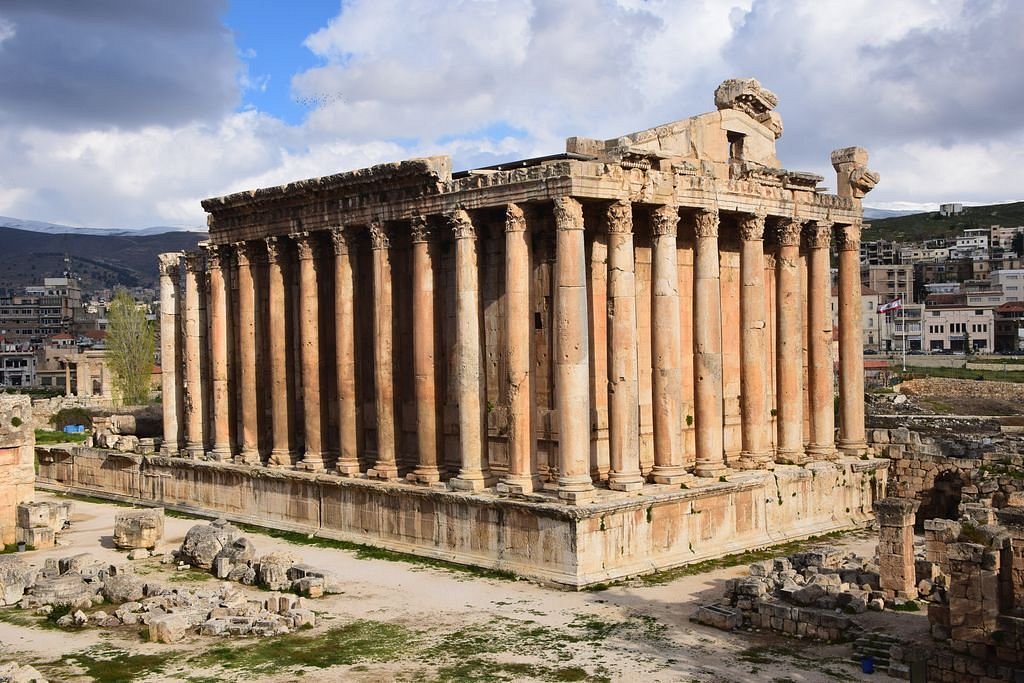
Visiting Baalbek, deep in Lebanon’s Beqaa Valley, was one of those moments in travel when history ceases to be something you read about and instead becomes something you stand inside. My journey from Beirut to Cairo was already shaping up to be an extraordinary overland passage through the Middle East, but Baalbek stood out as a place where time seemed to fold in on itself. Ancient, monumental, and quietly defiant, the ruins rose from the fertile valley with a presence that was both awe-inspiring and humbling.
Leaving Beirut, the road climbed steadily eastward, winding through mountain passes that offered sweeping views of terraced hillsides and distant peaks. The Mediterranean faded behind me, replaced by a broader, more open landscape. The Beqaa Valley felt expansive and timeless—an agricultural heartland framed by the Lebanon and Anti-Lebanon mountain ranges. This was land that had sustained civilizations for thousands of years, and as Baalbek came into view, it became clear why.
Even from a distance, the scale of the ruins was unmistakable. Columns pierced the sky, massive stone blocks stacked with impossible precision, their sheer size challenging any assumption about what ancient engineers could accomplish. Baalbek does not ease you into its grandeur; it confronts you with it.
First Impressions of Baalbek
Walking toward the site, I felt a mix of anticipation and disbelief. I had seen photographs, of course, but nothing prepares you for standing beneath columns that tower over you like stone giants. The ruins are remnants of what was once Heliopolis, a city sacred to multiple civilizations—Phoenician, Greek, Roman, and later Byzantine. Each culture layered its beliefs, architecture, and ambitions onto the same sacred ground.
Passing through the monumental entrance, I was immediately struck by the symmetry and precision of the architecture. This was not just a religious site; it was a statement of power. The Romans, in particular, had transformed Baalbek into one of the grandest temple complexes ever built, rivaling anything in Rome itself.
The Temple of Jupiter: Scale Beyond Comprehension
The Temple of Jupiter dominates the site, and standing beneath its remaining columns felt almost unreal. Each column is over 20 meters tall, among the largest ever constructed in the ancient world. They rise from a platform built of stones so massive that even today their transport remains a mystery. The famous Trilithon stones, weighing hundreds of tons each, lie embedded in the foundation like quiet challenges to modern engineering logic.
I walked slowly, almost instinctively lowering my voice as though I were inside a cathedral. The air felt heavy with history. It was impossible not to imagine the ceremonies that once took place here—the processions, the sacrifices, the crowds gathered beneath banners and incense smoke. This was a place designed to inspire reverence and obedience, to remind visitors of divine power and imperial authority.
What struck me most was how intact the sense of scale remained. Even in ruin, Baalbek overwhelms. It does not require imagination to see its former glory; the stones themselves tell the story.
Layers of Civilisation
Moving through the complex, I became increasingly aware of the layers of history beneath my feet. Before the Romans, this was a sacred Phoenician site dedicated to Baal, the storm god. The Greeks later associated it with Helios, the sun god, giving the city its name—Heliopolis. Christianity eventually arrived, converting parts of the complex into churches, and later Islamic influences left their own marks.
Rather than erasing one another, these cultures coexisted in stone. Columns were reused, carvings repurposed, spaces redefined. Baalbek felt less like a ruin and more like a conversation across centuries—a dialogue between belief systems, empires, and peoples who all sought meaning in the same place.
The Temple of Bacchus: Unexpected Intimacy
While the Temple of Jupiter overwhelms with scale, the Temple of Bacchus surprised me with its detail and intimacy. Remarkably well preserved, it felt almost alive. Elaborate carvings adorned doorways and ceilings, vines and mythological figures frozen in stone. This was a temple dedicated to wine, fertility, and celebration—a contrast to the stern grandeur of Jupiter.
Stepping inside, I ran my fingers lightly along the carved stone, tracing patterns shaped nearly two thousand years ago. The craftsmanship was extraordinary. Every surface seemed deliberate, symbolic, expressive. Here, the ancient world felt less distant. I could imagine laughter echoing through the halls, music drifting through the air, rituals blending pleasure with spirituality.
Silence, Space, and Reflection
Despite Baalbek’s historical weight, the site itself was surprisingly quiet. There were few visitors, and the vastness of the ruins meant that solitude was easy to find. I sat on a fallen block of stone and simply absorbed the atmosphere. The Beqaa Valley stretched out beyond the ruins, green and fertile, framed by mountains that seemed unchanged since antiquity.
It was in that stillness that Baalbek revealed its emotional depth. This was not just about architecture or history—it was about endurance. Baalbek has survived earthquakes, invasions, religious shifts, and modern conflict. It has been damaged, repurposed, neglected, and rediscovered, yet it remains.
Context of the Journey
Visiting Baalbek during a journey from Beirut to Cairo added another layer of meaning. I was not just moving through space but through history. Lebanon itself felt like a crossroads—of cultures, faiths, and narratives—and Baalbek embodied that complexity perfectly.
As I continued southward on my journey, toward Syria, Jordan, and eventually Egypt, Baalbek became a reference point. Other ancient sites would follow—Petra, the pyramids, temples along the Nile—but Baalbek set the tone. It reminded me that civilizations rise and fall, but their ideas, ambitions, and beliefs leave marks that outlast borders and politics.
A Place That Demands Respect
Baalbek is not a place you rush through. It demands time, attention, and humility. The ruins do not explain themselves easily; they invite questions rather than provide answers. Who moved these stones? How did belief shape architecture on such a scale? What does it mean that multiple religions chose the same sacred ground?
Leaving Baalbek, I felt a mixture of awe and quiet gratitude. I had walked among stones that predated so much of recorded history, stones that had witnessed humanity at its most ambitious and most vulnerable.
Lasting Impressions
Long after leaving the Beqaa Valley, Baalbek stayed with me. In conversations with fellow travelers, in moments of reflection during the long road south, and even later when standing before the temples of Egypt, I found myself comparing everything back to that moment beneath the columns of Jupiter.
Baalbek was not just a highlight of my journey from Beirut to Cairo—it was a reminder of why I travel at all. To stand where others once stood, to feel the weight of history beneath my feet, and to be reminded that while our lives are fleeting, the human desire to build, believe, and endure is timeless.
In Baalbek, history is not something behind glass or confined to textbooks. It rises from the earth itself, immense and unapologetic, asking only that you stand still long enough to listen.
