
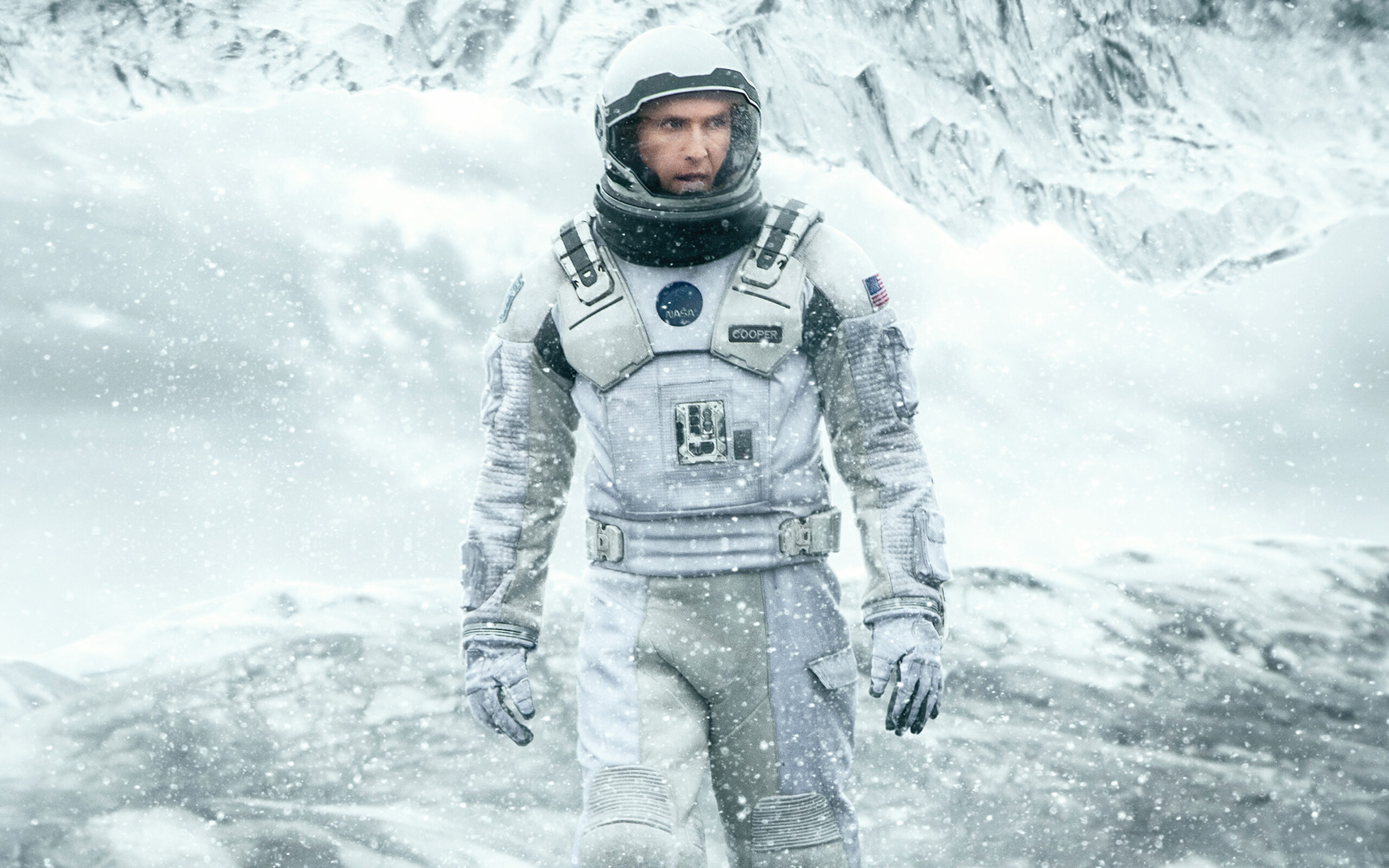
Interstellar – A Deep Exploration of Time, Love, and Survival
Released in 2014 and directed by Christopher Nolan, Interstellar is widely regarded as one of the most ambitious science fiction films ever made. Combining complex scientific theory with emotional storytelling, the film explores humanity’s struggle for survival, the nature of time, and the profound connection between parents and children. Starring Matthew McConaughey, Anne Hathaway, and Jessica Chastain, Interstellar blends astrophysics, philosophy, and human drama into a cinematic experience that has fascinated audiences and scientists alike.
Overview of the Story
The story of Interstellar takes place in a near-future Earth that is suffering from environmental collapse. Dust storms, crop failures, and famine threaten the survival of humanity. The planet is becoming increasingly uninhabitable due to blight, a disease that destroys crops and reduces oxygen levels in the atmosphere. Society has shifted its priorities away from technological advancement toward simple survival, and space exploration is considered a waste of resources.
Matthew McConaughey plays Cooper, a former NASA pilot turned farmer, who lives with his father-in-law Donald, his son Tom, and his daughter Murph. Murph, played as a child by Mackenzie Foy, is highly intelligent and shares a close emotional bond with her father. She believes that a “ghost” is communicating with her through unexplained patterns in her bedroom, such as books falling from shelves.
These patterns turn out to be coordinates leading Cooper to a secret NASA facility. NASA, led by Professor Brand (Michael Caine), has been working on a desperate plan to save humanity. A mysterious wormhole has appeared near Saturn, offering a shortcut to another galaxy containing potentially habitable planets. Cooper is recruited to pilot the spacecraft Endurance on a mission to explore these worlds and determine whether humans can relocate there.
Scientific Themes and Realism
One of the most distinctive aspects of Interstellar is its commitment to scientific realism. The film was developed with the guidance of Nobel Prize-winning physicist Kip Thorne, ensuring that many of the concepts portrayed have real theoretical foundations.
Wormholes
The wormhole in the film is based on real theoretical physics. A wormhole is a hypothetical tunnel connecting distant points in space-time, potentially allowing faster-than-light travel. In the film, astronauts pass through the wormhole to reach a distant galaxy containing planets that may support life.
Black Holes
The black hole Gargantua is one of the most scientifically accurate depictions ever shown in cinema. Its visual representation was created using real equations describing gravitational lensing, resulting in an image so realistic that it contributed to published scientific research.
Gargantua’s immense gravity causes extreme time dilation, meaning that time moves much slower near the black hole compared to Earth. On Miller’s planet, which orbits close to Gargantua, one hour equals seven years on Earth.
Time Dilation
Time dilation is a key concept in Einstein’s theory of relativity. It explains how time can pass at different rates depending on gravitational forces or relative speed. In the film, this leads to one of the most emotional moments when Cooper returns from Miller’s planet to discover that 23 years have passed for his children.
Emotional Core of the Film
Despite its scientific complexity, Interstellar is ultimately a story about love, sacrifice, and family. The relationship between Cooper and Murph is central to the narrative. Murph feels abandoned when her father leaves Earth to join the mission, believing that he chose humanity’s survival over his promise to stay with her.
As Murph grows older, played by Jessica Chastain, she becomes a scientist working to solve the gravitational equation needed to evacuate Earth’s population. Her anger toward her father evolves into understanding as she realizes the importance of his mission.
One of the film’s key themes is the idea that love transcends time and space. Dr. Amelia Brand, played by Anne Hathaway, suggests that love may be a force that connects people across dimensions. This idea is reinforced when Cooper, trapped inside a higher-dimensional structure called the tesseract, communicates with Murph through gravity.
The concept may seem abstract, but it gives emotional meaning to the scientific ideas explored throughout the film.
The Tesseract and Higher Dimensions
The climax of Interstellar introduces the concept of higher-dimensional space. Cooper enters the black hole Gargantua and finds himself inside a tesseract, a four-dimensional structure created by advanced beings. Within this space, he can see multiple moments in Murph’s childhood simultaneously.
This scene represents the idea that time is another dimension, much like space. Cooper uses gravity to send messages to Murph across time, ultimately enabling her to solve the equation that allows humanity to escape Earth.
The identity of the beings who created the tesseract is left open to interpretation, but the film suggests they may be evolved humans from the future who have learned to manipulate higher dimensions.
Visual Effects and Cinematography
The cinematography of Interstellar, created by Hoyte van Hoytema, plays a major role in the film’s impact. Many scenes were shot using IMAX cameras, providing incredible detail and scale.
The depiction of space feels vast and realistic, emphasizing both the beauty and danger of the universe. Practical effects were used whenever possible, such as building full spacecraft interiors instead of relying entirely on CGI.
The docking sequence, where Cooper manually spins the Endurance spacecraft to match the rotation of a damaged station, is one of the most intense scenes in modern science fiction cinema.
Music and Atmosphere
The musical score, composed by Hans Zimmer, is widely praised for enhancing the emotional and dramatic elements of the film. Nolan asked Zimmer to compose music based on the theme of parent-child relationships without revealing the film’s plot.
The result is a powerful organ-based soundtrack that creates both intimacy and grandeur. The music builds tension during scenes of danger while reinforcing the emotional connection between Cooper and Murph.
Zimmer’s score is often considered one of the best film soundtracks of the 21st century.
Themes and Philosophical Questions
Interstellar raises several philosophical questions:
Survival vs Humanity
Should humanity focus on survival at any cost, or preserve culture and identity? The film explores whether technological advancement is essential for survival.
The Nature of Time
The film suggests that time is not linear but may exist all at once. The tesseract scene presents time as something that can be navigated like physical space.
Love as a Universal Force
The film proposes that love might have measurable effects beyond human emotion. This idea bridges science and philosophy, suggesting that emotional connections may influence decisions in profound ways.
Critical Reception and Legacy
Interstellar received positive reviews from critics and audiences. While some viewers found the scientific explanations complex, many praised the film for its ambition and originality.
The film has inspired interest in astrophysics, space exploration, and theoretical physics. Scientists have used the film as a teaching tool to explain concepts such as relativity and black holes.
It is often compared to classic science fiction films such as:
- 2001: A Space Odyssey
- The Martian
- Contact
Conclusion
Interstellar stands out as a film that successfully combines scientific theory with emotional storytelling. Its exploration of time, gravity, and love creates a narrative that resonates on both intellectual and emotional levels.
Christopher Nolan’s direction, combined with strong performances, groundbreaking visual effects, and Hans Zimmer’s unforgettable music, has made Interstellar a modern classic.
The film encourages viewers to think about humanity’s future, the importance of exploration, and the power of human connection. It reminds us that curiosity and determination have always driven progress, and that even in the face of extinction, hope can guide humanity toward new possibilities.
