
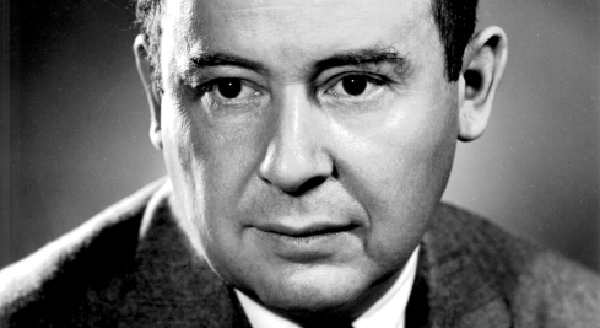
John von Neumann (1903–1957) stands as one of the most brilliant and influential intellects of the twentieth century. A polymath of extraordinary breadth, he made foundational contributions to mathematics, physics, computer science, economics, and national defense. Few individuals have shaped so many modern disciplines so deeply. From the architecture of digital computers to game theory, from quantum mechanics to nuclear strategy, von Neumann’s ideas continue to underpin how the contemporary world thinks, computes, and organizes itself.
Early Life and Education
John von Neumann was born on December 28, 1903, in Budapest, Hungary, into a wealthy and intellectually vibrant Jewish family. His father, Max Neumann, was a banker who ensured that John received the finest education available. From an early age, von Neumann displayed astonishing intellectual gifts. Family anecdotes recount that by the age of six he could divide eight-digit numbers in his head and converse fluently in classical Greek. He also possessed a prodigious memory, capable of recalling pages of text verbatim after a single reading.
Recognizing both his mathematical genius and the practical concerns of career security, his parents encouraged a dual educational path. Von Neumann studied chemistry at the Swiss Federal Institute of Technology (ETH Zurich), earning a degree in chemical engineering in 1925, while simultaneously pursuing advanced mathematics at the University of Budapest. In 1926, at just 22 years old, he obtained a doctorate in mathematics. His early work already showed signs of the rigor and abstraction that would characterize his later contributions.
Contributions to Mathematics
Von Neumann’s impact on pure mathematics was profound and wide-ranging. One of his earliest major achievements was in set theory and the foundations of mathematics. He made critical advances in axiomatic set theory, helping to clarify and resolve paradoxes that had troubled mathematicians since the late nineteenth century. The von Neumann universe, a cumulative hierarchy of sets, remains central to modern set theory.
In functional analysis, von Neumann was a key figure in the development of operator theory. He introduced the concept of Hilbert spaces as a rigorous mathematical framework for infinite-dimensional spaces, which later became indispensable in quantum mechanics. His work on rings of operators, now known as von Neumann algebras, opened an entire field of mathematical research that continues to thrive today.
These mathematical foundations were not merely abstract achievements; they were deeply connected to physical theory and computation. Von Neumann had a rare ability to see how pure mathematics could serve as a precise language for the natural sciences.
Quantum Mechanics and Physics
In physics, von Neumann played a central role in establishing the mathematical foundations of quantum mechanics. His 1932 book Mathematical Foundations of Quantum Mechanics provided the first fully rigorous axiomatic treatment of the theory. He formalized the role of operators, states, and measurements within Hilbert spaces, shaping how generations of physicists understood quantum theory.
Although some of his interpretations—particularly regarding the measurement problem—have been debated and refined over time, his formalism remains essential. Von Neumann’s work helped transform quantum mechanics from a collection of physical insights into a disciplined mathematical framework.
He also contributed to fluid dynamics, shock waves, and nuclear physics. During World War II, these interests would become deeply entwined with military research, particularly in relation to the Manhattan Project.
The Birth of Computer Science
Perhaps von Neumann’s most widely recognized legacy lies in computer science. During the 1940s, he became involved in the development of electronic digital computers, notably through his work on the EDVAC (Electronic Discrete Variable Automatic Computer). In his famous 1945 report, First Draft of a Report on the EDVAC, von Neumann articulated the concept of a stored-program computer.
This architecture—now known as the von Neumann architecture—proposed that both data and instructions be stored in the same memory and processed by a central processing unit. While not the only possible design, it became the dominant model for general-purpose computers and remains influential to this day.
Von Neumann foresaw many of the challenges and possibilities of computing long before the technology matured. He understood issues such as program complexity, error propagation, and the limitations imposed by hardware. His thinking laid the groundwork not only for computer engineering but also for theoretical computer science.
Game Theory and Economics
Another of von Neumann’s transformative contributions was the creation of game theory. In 1928, he proved the minimax theorem, establishing the mathematical foundation for analyzing strategic decision-making in competitive situations. This work was later expanded in collaboration with economist Oskar Morgenstern in their 1944 book Theory of Games and Economic Behavior.
Game theory revolutionized economics by introducing rigorous models of rational behavior under conditions of conflict and cooperation. Its influence extends far beyond economics into political science, biology, psychology, and artificial intelligence. Concepts such as equilibrium, strategy, and payoff—now commonplace—owe much to von Neumann’s original insights.
During the Cold War, game theory also became a tool for military strategy and nuclear deterrence, an application that von Neumann himself actively supported.
War, Strategy, and Controversy
Von Neumann was deeply involved in military research during and after World War II. As a consultant on the Manhattan Project, he contributed to the mathematics of implosion mechanisms used in nuclear weapons. Later, he became a prominent figure in U.S. defense policy, advising on ballistic missiles, nuclear strategy, and Cold War deterrence.
Unlike some scientists who grew increasingly uneasy about nuclear weapons, von Neumann took a hardline stance. He argued that nuclear superiority was essential to national security and supported policies of deterrence based on overwhelming force. These views remain controversial and complicate assessments of his legacy.
They also highlight a recurring tension in von Neumann’s life: the application of pure intellect to morally and politically charged problems. He believed strongly in rational decision-making, even in contexts where the consequences were catastrophic.
Personality and Working Style
Beyond his intellectual achievements, von Neumann was known for his vibrant personality. He was sociable, humorous, and famously enjoyed lavish parties. Colleagues often remarked on his ability to perform complex calculations mentally while engaged in casual conversation, even in noisy environments.
His working style was fast and intuitive. Unlike mathematicians who labored meticulously over proofs, von Neumann often grasped solutions almost instantly, writing them down with minimal revision. This brilliance could be intimidating, but he was also known for generosity toward younger scholars and collaborators.
Illness and Death
In the mid-1950s, von Neumann was diagnosed with cancer, likely linked to radiation exposure from nuclear weapons testing. As his health declined, he experienced a profound shift in outlook, becoming more reflective and, according to some accounts, more religious.
He died on February 8, 1957, at the age of 53. Despite his relatively short life, the scope and depth of his contributions were extraordinary.
Enduring Legacy
John von Neumann’s legacy is difficult to overstate. Modern computers still reflect the architectural principles he articulated. Economists and strategists rely on game theory to model behavior. Physicists continue to use the mathematical frameworks he helped establish. Even emerging fields such as artificial intelligence and complex systems echo his early insights into computation and self-replicating machines.
More broadly, von Neumann exemplifies the power—and the peril—of human intellect applied without boundaries. He showed how abstract reasoning could reshape the world, for better and worse. His life invites reflection not only on what humans can know and build, but also on how such knowledge should be used.
In this sense, John von Neumann remains not just a historical figure, but a continuing presence in the intellectual fabric of modern civilization.
