
New York City is not a place you simply visit; it is a place that happens to you. From the moment I arrived, the city announced itself with noise, motion, and an almost overwhelming sense of scale. Sirens echoed between skyscrapers, subway trains rumbled beneath the streets, and crowds flowed in every direction with purpose and momentum. It felt less like entering a city and more like stepping into a living system that never truly pauses.
Unlike destinations defined by a single landmark or experience, New York is a collage of moments — fleeting, unscripted, and intensely human. Each neighbourhood tells its own story, shaped by generations of migration, ambition, struggle, and creativity. Walking its streets, I quickly understood why so many people describe New York not as a place, but as an energy.
First Impressions and Orientation
Arriving in Manhattan, I was immediately struck by the verticality of the city. Buildings seemed to compete for the sky, their glass and steel faces reflecting light in unpredictable ways. The grid layout made navigation deceptively simple, yet every block felt different — a shift in architecture, atmosphere, or pace.
Times Square was my first major encounter, and it was as chaotic and theatrical as expected. Giant screens pulsed with colour, music bled from open doorways, and tourists mingled with street performers and commuters who navigated the crowds with practiced indifference. It was sensory overload in the most literal sense, but also strangely exhilarating.
Walking the City
New York reveals itself best on foot. Wandering through neighbourhoods like Midtown, Harlem, SoHo, and the Lower East Side, I began to appreciate the city’s layered identity. Historic brownstones sit alongside modern high-rises, independent bookstores coexist with global brands, and quiet residential streets are never far from major arteries of traffic.
Central Park offered a moment of contrast — a vast green refuge amid concrete and glass. Walking its paths, I watched runners pass cyclists, families picnic beneath trees, and musicians perform to small, appreciative crowds. The park felt like a shared living room for the city, a space where different lives briefly intersect.
The Rhythm of Daily Life
What stood out most was the rhythm of New York life. People move with intent — fast, direct, unapologetic. There is little time for hesitation, yet beneath that efficiency is a sense of coexistence. Everyone seems to understand the unspoken rules: keep moving, mind your space, and respect the flow.
Subway travel reinforced this impression. Platforms buzzed with conversation, music, and the sound of approaching trains. Despite the density, there was an unspoken order — people queued, navigated crowds instinctively, and helped each other when needed. It was chaotic, yes, but functional in its own way.
A Brief Encounter with Law Enforcement
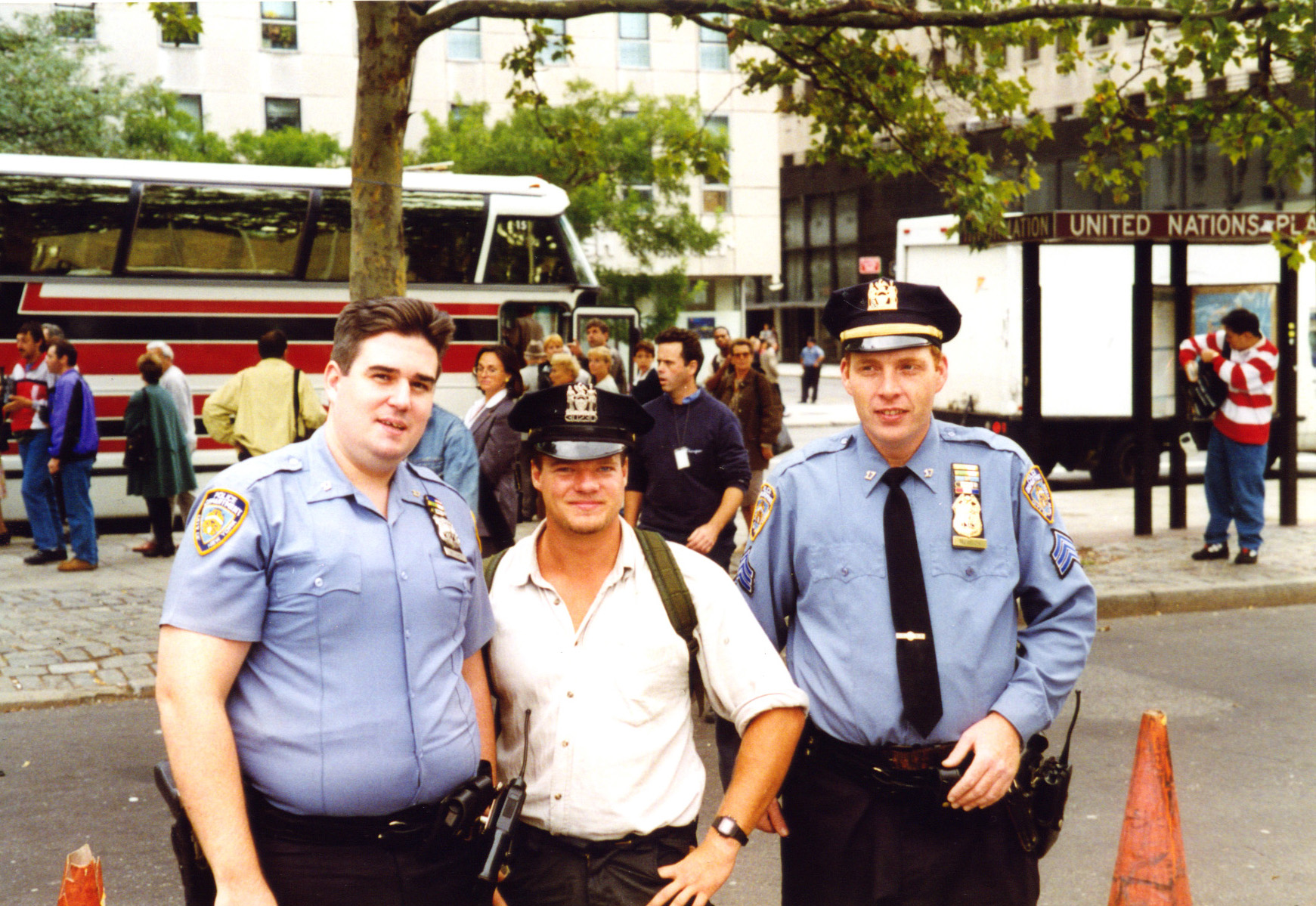
During one afternoon walk through a busy part of Manhattan, I had a brief but memorable encounter with a couple of NYPD officers stationed near a crowded intersection. They were managing foot traffic and keeping an eye on the steady flow of people — a familiar sight in a city that never seems to slow down.
What started as a casual moment quickly turned into something more light-hearted. Before the days of selfies, there was a quick, good-natured exchange about whether it was the right time for a photo. Once that was settled, the mood relaxed instantly. The officers were approachable, friendly, and clearly used to tourists wanting a snapshot of their New York experience.
Standing next to them, the physical contrast was impossible to ignore. I’m about 5’7” on average, but beside these officers I felt noticeably smaller — they absolutely towered over me, reinforcing every stereotype about the imposing presence of the NYPD. The height difference alone became part of the humour of the moment.
One of the officers leaned into the joke even further by casually placing his police cap on top of my head, prompting laughter all around. It was an entirely human moment — informal, friendly, and completely unexpected. The photo captured not authority or seriousness, but personality and warmth.
Like so many moments in New York, it was brief, unscripted, and oddly memorable, blending seamlessly into the larger experience of the city.
Cultural Layers
One of New York’s most compelling qualities is its cultural density. Museums like the Metropolitan Museum of Art and the Museum of Modern Art offer world-class collections, but culture extends far beyond formal institutions. Street art, music, food, and language all contribute to the city’s creative identity.
I wandered into neighbourhoods where languages shifted from block to block, menus changed entirely within a few streets, and cultural traditions were proudly maintained. From food carts selling dishes from every corner of the globe to small jazz venues tucked into basements, the city felt like a living archive of global influence.
Evenings in the City
As daylight faded, New York transformed. The city didn’t slow down — it simply changed gears. Neon lights illuminated streets, bars and restaurants filled with conversation, and the hum of activity deepened rather than diminished.
Walking at night felt safe yet alive, with people everywhere — dining, commuting, performing, simply existing. The city’s reputation for toughness softened into something more nuanced: resilience, adaptability, and a collective understanding of how to share space.
Moments of Stillness
Despite its reputation, New York offers moments of surprising stillness. Sitting on a bench along the Hudson River, watching the sun dip behind the skyline, I felt a rare quiet. Ferries moved slowly across the water, joggers passed in steady rhythm, and the city seemed to breathe.
It was in these moments that the scale of New York felt most profound — not as something overwhelming, but as something balanced by countless small, human experiences.
Reflections on the City
New York does not try to impress; it simply exists at full intensity. It challenges visitors to keep up, to adapt, and to observe without expectation. It is a city that rewards curiosity and resilience, offering depth to those willing to look beyond the obvious.
The brief interaction with law enforcement, like so many small moments, reinforced the sense that New York operates through constant coordination. Millions of lives intersect daily, held together by systems, routines, and shared understanding.
Leaving New York
Leaving the city, I felt a mixture of relief and longing. New York demands attention and energy, but it also gives back perspective. It reminds you how small individual moments can be within a vast collective, yet how meaningful those moments become when experienced fully.
New York is not defined by a single sight, sound, or story. It is defined by movement — of people, ideas, and ambition. Visiting it is less about ticking off landmarks and more about absorbing its pulse, its contradictions, and its relentless vitality.
Conclusion
Visiting New York City is an immersion into motion, diversity, and shared space. It is a place where brief encounters — whether with strangers, performers, or even law enforcement — become part of a larger, constantly unfolding narrative.
The city does not ask to be understood fully. It asks only that you participate, even briefly, in its rhythm. And once you do, it leaves an impression that lingers long after you’ve gone.
