
There are places on Earth that resist simple description, places so vast and ancient that language struggles to capture their scale and significance. The Grand Canyon is one of those places. Standing at its rim, looking out across an expanse carved by time itself, I felt a deep sense of awe that was both humbling and grounding. It is not just a place you visit; it is a place that confronts you with perspective — geological, historical, and deeply personal.
Approaching the Canyon
The journey to the Grand Canyon builds anticipation slowly. Driving through northern Arizona, the landscape appears deceptively ordinary at first — pine forests, rolling plains, and open sky. There is little warning of what lies ahead. Then, almost without ceremony, the land falls away. One moment you are walking on solid ground; the next, you are standing at the edge of something immeasurable.
That first glimpse of the canyon is disorienting. The earth opens up into a vast chasm of rock, shadow, and color that stretches far beyond the limits of vision. It feels less like looking at a landscape and more like staring into the past — layers upon layers of history exposed in stone.
First Impressions
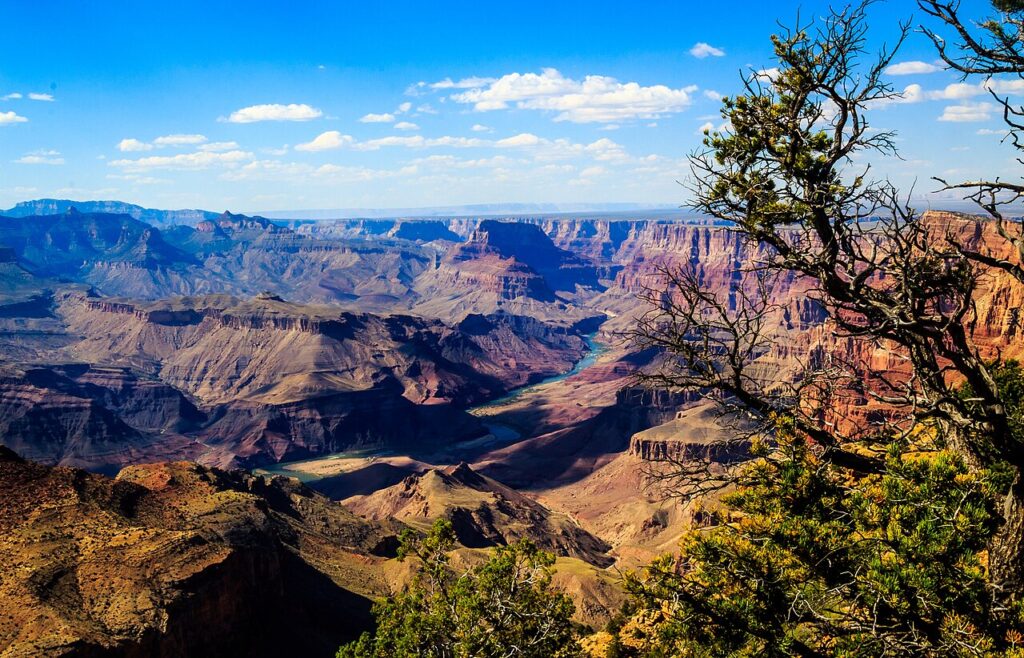
My initial reaction was silence. Not the absence of sound, but the kind of quiet that demands attention. The canyon absorbs noise, swallowing voices and footsteps, leaving only the wind and the distant cry of birds. The sheer scale makes it impossible to fully comprehend in one glance. No photograph prepares you for the depth, the width, or the complexity of the terrain.
The canyon walls glow with shades of red, orange, gold, and deep purple, shifting constantly as the light changes. Shadows stretch and retract across the rock faces, revealing new contours and details with every passing minute. It is a landscape in motion, shaped by time and light as much as by the Colorado River far below.
Walking Along the Rim
Walking along the rim, I found myself stopping frequently — not from fatigue, but from the need to absorb what I was seeing. Each viewpoint offered a slightly different perspective, a new arrangement of rock formations, ridges, and valleys that felt both familiar and entirely new.
From some angles, the canyon appeared impossibly wide; from others, the depth dominated the view. The Colorado River, visible only in glimpses, looked like a thin ribbon of green far below, its immense power disguised by distance. Knowing that this river carved the canyon over millions of years added a layer of reverence to the experience. This was erosion on a scale beyond human comprehension.
A Sense of Deep Time
One of the most profound aspects of visiting the Grand Canyon is the awareness of deep time. The exposed rock layers represent nearly two billion years of Earth’s history. Standing there, I felt the weight of that timescale — the realization that human history occupies only the thinnest sliver of this geological story.
Each layer tells a different chapter: ancient seas, shifting continents, volcanic activity, and relentless erosion. It is humbling to realize how brief our presence is in comparison. The canyon does not just show you the past; it places you within it, reminding you of your place in a vast, unfolding narrative.
The Play of Light and Shadow
As the day progressed, the canyon transformed. Morning light softened the landscape, while midday sun revealed the sharp contrasts and textures of the rock. In the afternoon, shadows deepened, adding drama and mystery to the scene.
I lingered near one viewpoint for over an hour, watching as the light changed almost imperceptibly. The canyon seemed alive, breathing with the movement of the sun. Colors intensified, shadows crept along the walls, and the entire landscape shifted before my eyes. It was a reminder that the Grand Canyon is not static; it is a dynamic, ever-changing environment shaped by forces both ancient and immediate.
Sounds and Sensations
Despite its vastness, the Grand Canyon has an intimate quality. The wind whispers through the rocks, carrying the scent of pine and dust. Birds glide effortlessly across the open space, their calls echoing faintly against the canyon walls. Occasionally, the distant voices of other visitors drift through the air, quickly swallowed by the immensity of the space.
Standing near the edge, I could feel the warmth of the sun on my skin and the cool breeze rising from the depths below. The combination of heat, wind, and silence created a sensory experience that was both calming and invigorating. It was impossible not to feel fully present, anchored in the moment.
Human Presence and Perspective
Amid such grandeur, human presence feels small. Visitors line the viewpoints, yet they appear insignificant against the backdrop of the canyon. This sense of scale fosters a rare kind of humility — a reminder that while humans shape their environments, there are forces far greater than us at work.
I thought about the indigenous peoples who have lived in and around the canyon for thousands of years, developing deep spiritual connections to the land. Their relationship with the canyon is not one of conquest or domination, but of respect and coexistence. That perspective felt particularly meaningful in a place shaped by time rather than ambition.
Personal Reflection
As I stood there, I found myself reflecting on my own journey — not just the physical journey that brought me to the Grand Canyon, but the personal paths I had taken in life. The canyon’s immense scale put my own concerns into perspective. Problems that once felt overwhelming seemed smaller, more manageable, when viewed against the backdrop of millions of years of natural history.
There was a sense of clarity that came from that realization. The canyon does not offer answers, but it offers perspective. It encourages patience, resilience, and acceptance — qualities shaped by time and endurance.
Sunset at the Canyon
As the sun dipped toward the horizon, the canyon entered its most dramatic phase. The light softened and warmed, bathing the rock formations in deep reds and golds. Shadows lengthened, creating bold contrasts that emphasized the canyon’s depth and complexity.
Sunset at the Grand Canyon is a communal experience. Visitors gather quietly, sharing the moment in near silence. As the sun disappeared, a hush fell over the crowd. The canyon darkened gradually, revealing layers of shadow and light until only silhouettes remained. It was a moment of shared reverence, a reminder of the power of nature to unite people in wonder.
Why the Grand Canyon Endures
The Grand Canyon endures not just because of its size, but because of what it represents. It is a testament to patience, resilience, and the slow, persistent forces that shape our world. It reminds us that beauty does not always come from immediacy or perfection, but from time, change, and endurance.
Visiting the Grand Canyon is a lesson in perspective. It strips away distractions and invites reflection. It challenges you to see beyond the surface and to appreciate the deeper stories written into the land.
Conclusion
Leaving the Grand Canyon, I felt changed in subtle but meaningful ways. The experience had been grounding, humbling, and deeply inspiring. It reminded me of the vastness of the world and the fleeting nature of our time within it.
The Grand Canyon is not just a destination; it is an encounter with time itself. Standing at its edge, you are reminded that some things cannot be rushed, simplified, or fully understood — they must be experienced, contemplated, and respected. Long after the journey ends, the memory of that vast, ancient landscape remains, quietly reshaping the way you see the world.
