
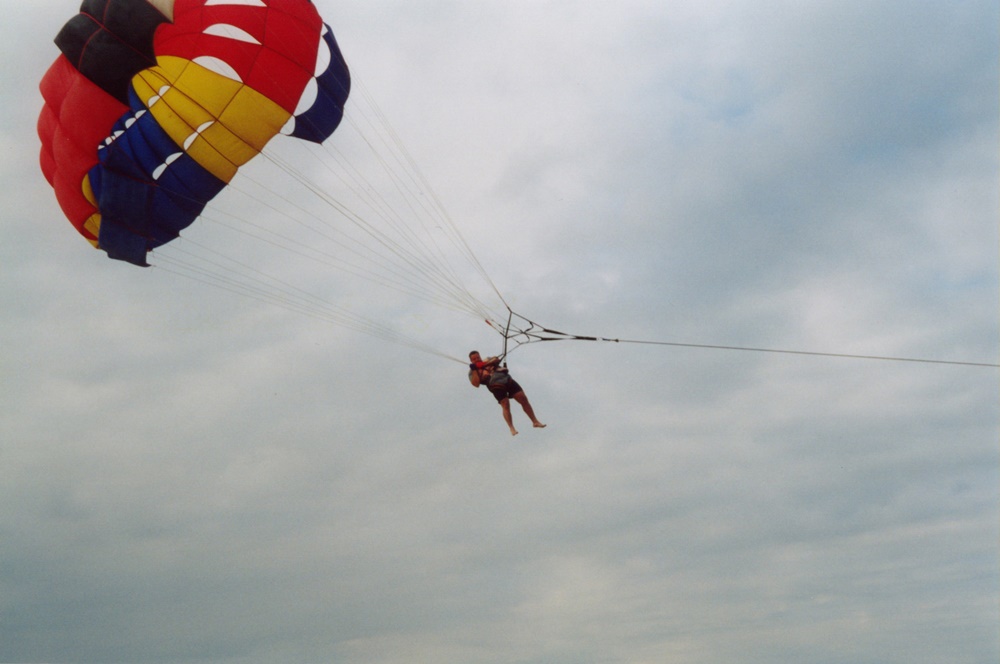
After spending a couple of intense and rewarding weeks in Bali, Indonesia, the island had begun to feel both familiar and full of possibility. By that point in the trip, I had just completed my PADI Advanced Open Water Diver (AOW) qualification — a milestone that represented not only improved technical skills, but a deeper confidence in myself. The dives had pushed me beyond comfort: deeper water, night dives, navigation, and decision-making under pressure. Naturally, completing the course felt like something worth celebrating.
Rather than marking the achievement quietly, I found myself looking for another challenge — something different, something that would stretch me in a new way. Bali, with its endless menu of adventure activities, makes that temptation almost unavoidable. Among the options — surfing, jet skiing, paragliding — parasailing stood out. It promised height, exposure, and perspective, all without the physical exertion of diving or trekking. It also carried a certain unpredictability that made it both enticing and slightly unsettling.
Bali’s Atmosphere of Adventure
Bali has a unique way of encouraging you to say yes. The island feels alive with movement: scooters weaving through traffic, waves breaking endlessly on the shore, ceremonies unfolding beside beach bars. Adventure activities are advertised everywhere, often casually, almost as an afterthought to a day at the beach.
After days of diving, my days had fallen into a comfortable rhythm — early starts, equipment checks, underwater focus, post-dive debriefs. Completing the AOW course disrupted that routine in a good way. Suddenly, there was no schedule to follow, no next dive briefing to attend. That sense of open time made the idea of parasailing feel like a natural next step.
It was less about ticking off another activity and more about embracing the mindset the trip had created — curiosity over caution, experience over certainty.
Deciding to Go for It
The parasailing operation was set up along the coast, informal and straightforward. Equipment lay in neat piles, boats bobbed offshore, and instructors chatted casually among themselves. It all looked functional enough, though not particularly polished.
What gave me pause was the instructors themselves. They were young lads, clearly enthusiastic, but their confidence felt uneven. They weren’t careless, but they also didn’t project the calm authority I had grown accustomed to during my diving course. Having just completed AOW, I was acutely aware of how much competence and quiet confidence matters when safety is involved.
For a moment, I hesitated. The sensible part of my mind raised questions: Was the equipment well maintained? Were procedures properly followed? Did I trust these people with my safety?
And yet, there are moments in travel where logic competes with instinct. This felt like one of those moments. Not reckless, but deliberate — a conscious decision to step outside comfort again, even with uncertainty present.
Preparing for Flight
The preparation was surprisingly brief. A harness was fitted, straps tightened, a few instructions given. There was no long safety briefing, no layered explanation — just a few key points and a lot of assumption.
Standing there, I became acutely aware of how different this felt compared to diving. Underwater, everything had been methodical, precise, and procedural. Parasailing felt more improvisational, more dependent on momentum and trust.
The boat idled offshore, the parasail canopy spread out behind it like a giant wing waiting to be filled. As I was clipped in, the reality of what I had agreed to became impossible to ignore. This wasn’t something I could back out of gracefully.
The Moment of Take-Off
Once the boat began to move, everything happened quickly. The line tightened, the canopy caught the wind, and suddenly I was no longer standing on solid ground. There was no dramatic jolt — just a smooth, steady lift as the beach dropped away beneath me.
Almost instantly, the noise faded. The shouts from the shore disappeared, replaced by the sound of wind and the distant hum of the boat’s engine. The feeling was extraordinary — not like flying, but like being gently pulled into the sky.
Despite my earlier doubts, the transition was surprisingly calm.
Perspective from Above
As I rose higher, Bali revealed itself in layers. The shoreline curved elegantly beneath me, waves breaking in perfect, repeating patterns. Boats moved slowly across the water, their wakes carving pale lines into the blue.
From this height, the island looked softer, less chaotic. The traffic, the noise, the heat — all of it seemed to fade away. What remained was colour and movement, sea and sky blending seamlessly.
Having spent days exploring Bali underwater during my AOW course, seeing it from above felt like completing a circle. I had experienced the island from the depths, and now from the air.
Trusting the Moment
Despite the beauty, part of my awareness never fully relaxed. The knowledge that the instructors hadn’t inspired complete confidence lingered at the back of my mind. Every change in tension, every shift in wind, was felt more keenly because of that awareness.
Yet, paradoxically, that made the experience more meaningful. This wasn’t passive enjoyment. It was active presence — being fully aware of where I was, how I felt, and what was holding me aloft.
At some point, the balance shifted. The tension gave way to acceptance. There was nothing to do but trust the equipment, the wind, and the moment itself.
Suspension and Stillness
What surprised me most was the stillness. Suspended high above the sea, time seemed to slow. There was no sense of speed, no rush. Just the gentle sway of the harness and the endless horizon stretching outward.
It felt meditative in an unexpected way. Unlike diving, where awareness is focused inward — breathing, depth, buoyancy — parasailing pulled attention outward. The world became the subject, not the self.
The Descent
Eventually, the boat slowed, and the line began to shorten. The descent was gradual, almost anticlimactic. The sea rose up to meet me, the sounds of the beach returned, and the sense of isolation dissolved.
Touching down felt grounding in every sense of the word. The moment my feet hit the boat, I felt a wave of relief followed closely by exhilaration. The instructors smiled, clearly pleased with a successful flight.
Despite my earlier doubts, everything had worked as it should.
Reflection After the Flight
Looking back, parasailing in Bali was not about flawless execution or polished professionalism. It was about choice. Choosing to step into uncertainty, to trust beyond comfort, and to experience something fully despite reservations.
Completing my PADI Advanced Open Water course had shifted something in me. It had built confidence, not recklessness — the confidence to assess risk, acknowledge doubt, and still move forward when it felt right.
Parasailing became a celebration not just of a qualification, but of growth.
Final Thoughts
Bali offers countless opportunities for adventure, but not all of them are equal in polish or predictability. Parasailing, in this case, was imperfect — and perhaps that’s why it remains so memorable.
Suspended between sea and sky, I was reminded that travel is not just about comfort or safety, but about experience. Sometimes, the moments that stay with us most are the ones where we pause, hesitate, and then decide to go anyway.
It wasn’t the most technically impressive activity I did in Bali, nor the most controlled. But it was one of the most revealing — a moment of trust, perspective, and quiet exhilaration, high above the island that had already given me so much.
