
While visiting a friend in Bahrain, I decided to extend my journey by spending several days in Dubai. Having already experienced the modern, futuristic side of the city – the towering skyscrapers, immaculate shopping malls, and bustling streets — I was keen this time to experience something different. I wanted to see the landscape that existed long before Dubai became a global metropolis. That desire led me to one of the most memorable activities of the trip: a Jeep safari across the deserts of Dubai, an experience that combined adventure, natural beauty, cultural insight, and a surprising cross-border moment when we crossed briefly into Oman.
Leaving the City Behind
The day of the safari began in sharp contrast to the environment I was about to enter. Dubai in the morning is a city of glass, steel, and motion. Our 4×4 Jeep picked us up from the city, and as we drove away from the skyline, the scenery gradually transformed. Skyscrapers gave way to highways, highways to open land, and eventually the city disappeared altogether.
There is something striking about how abruptly Dubai ends and the desert begins. One moment you are surrounded by modern infrastructure; the next, you are looking at endless stretches of sand and sky. The transition felt symbolic — as though I was leaving behind the present and stepping into a landscape shaped by time, wind, and survival.
Entering the Desert
Once we reached the edge of the desert, the driver stopped to adjust tyre pressure. This small pause heightened the sense of anticipation. Our guide explained that lowering the tyre pressure allowed the Jeep to grip the sand more effectively, an essential preparation for what lay ahead.
As soon as we set off again, the terrain changed dramatically. The road disappeared, replaced by rolling dunes that seemed to stretch endlessly in every direction. The desert was not flat, as I had subconsciously imagined, but alive with shape and movement — tall dunes, sharp ridges, soft valleys, and wind-sculpted curves.
The heat was ever-present, but the desert air felt different from city heat — drier, cleaner, more elemental. The vast openness was immediately humbling.
Dune Bashing: Controlled Chaos
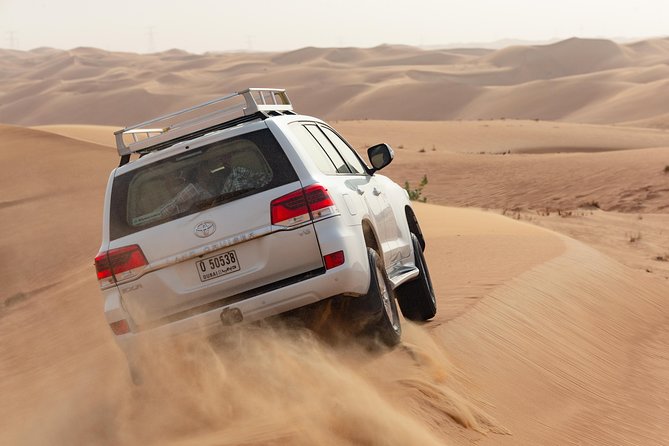
The heart of the Jeep safari was dune bashing, and it did not take long to understand why it is such a highlight. Our driver accelerated toward a dune, climbing it at an angle before suddenly descending the other side. The sensation was intense — part rollercoaster, part controlled freefall.
The Jeep tilted, slid, climbed, and plunged with surprising agility. At times it felt as though gravity had momentarily lost its grip. Sand sprayed against the windows, and laughter mixed with shouted exclamations from inside the vehicle. Despite the apparent chaos, the driver was calm and precise, clearly experienced and fully in control.
What struck me most was how alive the desert felt during this part of the journey. The dunes were not obstacles but features to be read, navigated, and respected. Each slope had its own character, and every movement of the vehicle was deliberate.
The Silence Between the Thrills
Between the bursts of adrenaline, there were moments of stillness. The driver would stop at the crest of a dune, allowing us to step out and take in the view. Standing there, surrounded by sand in every direction, the silence was profound.
There were no buildings, no engines, no human noise — just the wind shaping the dunes grain by grain. The desert felt ancient and indifferent, a reminder of how small and temporary we are in comparison. It was easy to understand how people had navigated these landscapes for centuries, guided by stars, instinct, and an intimate understanding of the environment.
Crossing Into Oman
One of the most unexpected aspects of the safari was learning that at one point we crossed into Oman. The border itself was subtle — there were no fences or obvious markers, just an invisible line across an immense natural landscape. The guide explained that certain desert safari routes pass close to or briefly into Omani territory, depending on the region and route chosen.
The idea of crossing an international border in the middle of the desert was fascinating. There were no signs announcing the transition, no checkpoints interrupting the flow of the journey. The desert looked the same — rolling dunes, vast sky — yet politically and culturally, we had momentarily entered another country.
That moment highlighted how artificial borders can feel in such a natural environment. The land itself did not change; only our understanding of where we were did. It added a quiet sense of significance to the experience, turning an adventure activity into something unexpectedly thought-provoking.
Desert Life and Survival
As we continued, the guide spoke about desert life — how people historically survived in such harsh conditions, how Bedouin tribes moved with the seasons, and how the desert provided both challenges and resources. Small details became meaningful: animal tracks in the sand, sparse vegetation clinging to life, and the way dunes shift over time.
It became clear that the desert is not empty, as it is often described, but subtly alive. Life here is simply adapted differently, existing quietly and efficiently.
Sunset Over the Dunes
As the day progressed, the light began to change. The sun lowered toward the horizon, and the desert transformed. The sand took on shades of gold, orange, and deep red, with shadows stretching across the dunes like brushstrokes.
We stopped once more to watch the sunset, and it was one of the most beautiful I have ever seen. The sky shifted slowly in colour, and the desert glowed softly beneath it. In that moment, the thrill of dune bashing gave way to calm reflection.
Watching the sun set in the desert felt deeply grounding. It was a reminder that long before cities and borders, people had stood in places like this, watching the same sky, experiencing the same quiet awe.
Cultural Experience in the Desert Camp
As evening fell, we arrived at a desert camp, where the experience shifted again. Traditional seating, soft lighting, and warm hospitality replaced the raw openness of the dunes. Food was served, and there was an opportunity to relax, talk, and reflect on the day.
The camp offered insight into regional culture — from traditional music to local cuisine — grounding the adventure in a broader cultural context. It was not just about adrenaline, but about connection: to the land, to history, and to people.
Reflection on the Experience
The Jeep safari was far more than an exciting activity. It was a journey through contrast — modern Dubai to ancient desert, adrenaline to silence, defined borders to boundless landscapes. Crossing briefly into Oman added an unexpected layer, reminding me how travel often reveals the artificial nature of lines we draw on maps.
Coming from Bahrain, a place with its own blend of tradition and modernity, the desert safari felt like a continuation of that theme — the meeting point between old and new, nature and development.
Final Thoughts
Looking back, the Jeep safari across the deserts of Dubai remains one of the most vivid experiences of my travels in the Middle East. It offered excitement without feeling superficial, reflection without feeling forced, and beauty without needing embellishment.
The desert does not try to impress — it simply exists, vast and patient. Experiencing it from the seat of a Jeep, feeling its power and calm in equal measure, and even crossing into another country without fanfare made the journey unforgettable.
It reminded me that sometimes the most meaningful travel experiences are not found in cities or landmarks, but in the spaces between — where the land speaks quietly, and all you have to do is listen.
