
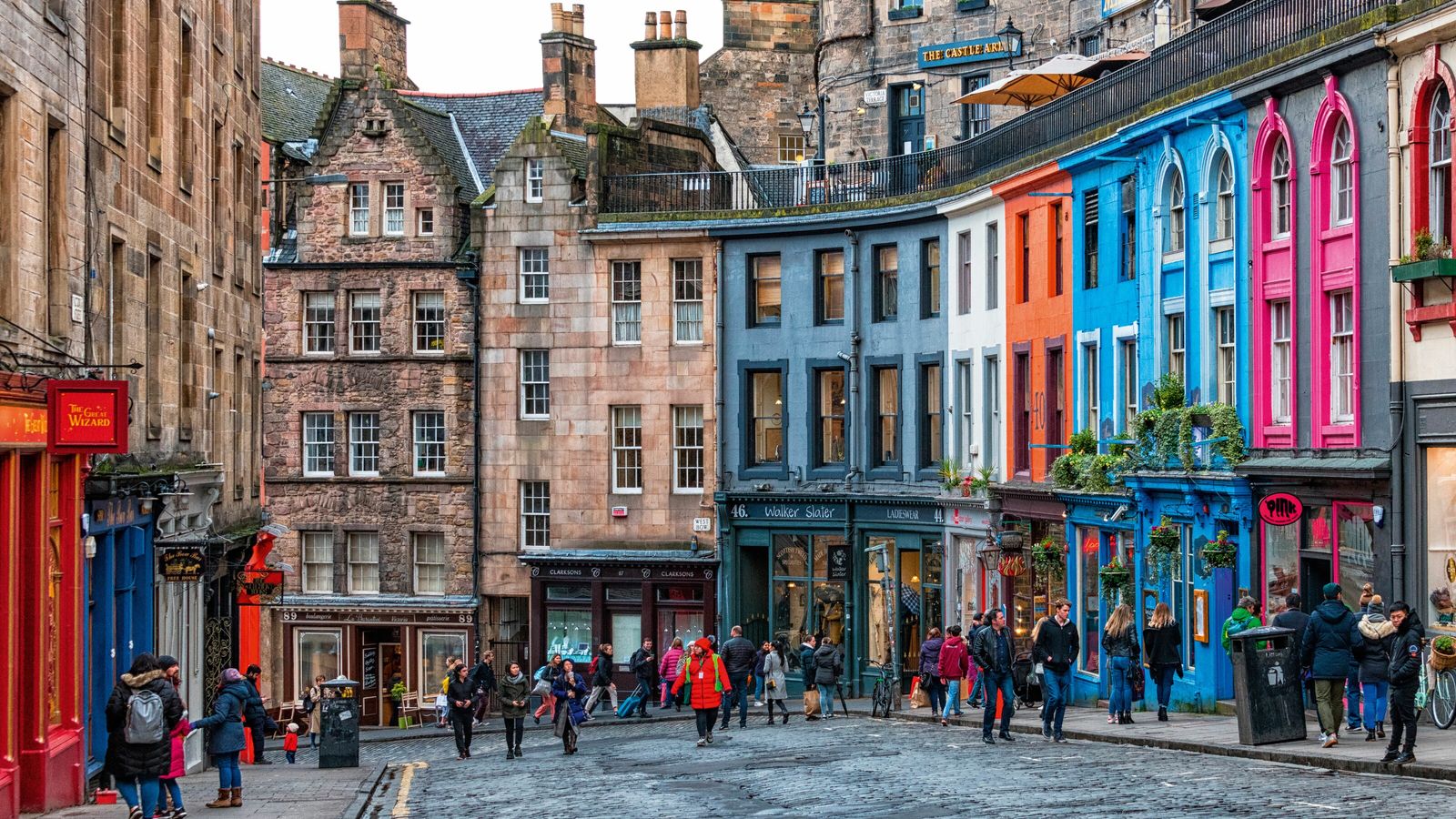
Victoria Street, Edinburgh, is one of the city’s most celebrated and visually striking thoroughfares, renowned for its sweeping curve, colourful shopfronts, and deep historical roots. Nestled in the Old Town and linking the Grassmarket below with the Royal Mile above, Victoria Street is far more than a picturesque attraction for visitors. It is a vivid expression of Edinburgh’s layered urban history, its 19th-century transformation, and its enduring cultural and commercial life. From medieval overcrowding and unsanitary conditions to Victorian urban planning and modern creativity, Victoria Street tells a story of reinvention that mirrors the evolution of Edinburgh itself.
Origins Before Victoria Street
Before Victoria Street existed, the area was a dense maze of medieval closes and wynds descending steeply from the Lawnmarket to the Grassmarket. These narrow passages were home to overcrowded tenements, workshops, taverns, and small trades. The Grassmarket, long associated with livestock trading, markets, and public executions, was a bustling but rough part of the city, while the Lawnmarket above formed part of the Royal Mile’s main commercial artery.
By the late 18th and early 19th centuries, Edinburgh’s Old Town was widely regarded as unhealthy and antiquated. Overcrowding, poor sanitation, and limited access to light and air contributed to frequent outbreaks of disease. At the same time, the city was expanding northwards with the construction of the New Town, which embodied Enlightenment ideals of order, symmetry, and rational urban planning. In contrast, the Old Town increasingly came to be seen as a problem in need of reform rather than preservation.
Victorian Improvement and the Birth of Victoria Street
Victoria Street was created between 1829 and 1834 as part of a broader programme of Victorian urban improvement. The project was designed by the influential architect Thomas Hamilton, whose vision sought to modernise the Old Town while improving access between key areas of the city. The street was named after Princess Victoria, who would later become Queen Victoria, reflecting the era’s optimism and confidence in progress.
The construction of Victoria Street required the demolition of many older buildings and closes, a controversial but common practice during 19th-century redevelopment schemes. Unlike the rigid straight lines favoured in the New Town, Hamilton embraced the site’s natural topography, designing a gracefully curving street that follows the contour of the hillside. This curve not only adds to the street’s visual charm but also creates a sense of unfolding discovery as one walks along it.
One of Victoria Street’s most distinctive features is its two-level design. At street level are shops and businesses facing the curve of the road, while above them runs West Bow, an elevated terrace that allows pedestrians to walk along the upper level and look down onto the street below. This dual perspective is unusual and contributes significantly to the street’s architectural character.
Architectural Character and Design
Victoria Street is a striking example of 19th-century urban architecture, blending practicality with aesthetic flair. The buildings are primarily constructed from local stone, with tall façades that reflect the vertical emphasis typical of Edinburgh’s Old Town. Large windows on the upper floors allowed more light into interiors than earlier medieval buildings, while decorative details added a sense of elegance and individuality.
In more recent decades, many shopfronts have been painted in bold, vibrant colours, creating the rainbow-like appearance for which Victoria Street is now famous. While these colours are largely a modern addition rather than an original Victorian feature, they have become an iconic part of the street’s identity and contribute to its popularity in photography and film.
The street’s gentle slope and curve create constantly shifting viewpoints. From the Grassmarket end, Victoria Street rises dramatically, offering glimpses of the Royal Mile above, while from the top, the street opens out towards Edinburgh Castle looming nearby. This relationship with the surrounding landmarks enhances the sense that Victoria Street is deeply embedded within the city’s historic fabric rather than standing apart from it.
Commercial Life Through the Centuries
From its inception, Victoria Street was intended to be a commercial hub, replacing the chaotic and unsanitary trading spaces that previously occupied the area. In the 19th century, it was home to a wide variety of shops and trades, including butchers, bakers, candlemakers, ironmongers, and other everyday businesses serving the local population.
The street was particularly associated with the meat trade, as butchers relocated from the older closes to more modern premises along Victoria Street. This commercial continuity with the Grassmarket below reinforced the area’s role as a centre of trade and daily life rather than an elite or ceremonial space.
In the 20th century, like many historic shopping streets, Victoria Street experienced periods of decline as retail patterns changed and suburban shopping centres drew customers away. However, its fortunes revived in the late 20th and early 21st centuries as interest in heritage, independent businesses, and urban living grew.
Today, Victoria Street is known for its independent shops, including artisan food stores, bookshops, gift shops, clothing boutiques, cafés, and restaurants. This emphasis on small, characterful businesses sets it apart from more commercialised shopping areas and reinforces its reputation as a creative and distinctive part of the city.
Cultural Associations and Popular Imagination
Victoria Street has become deeply embedded in Edinburgh’s cultural identity, both locally and internationally. It is frequently cited as an inspiration for Diagon Alley in the Harry Potter series, due to its narrow curve, stacked levels, and eclectic shopfronts. While there is no definitive confirmation from J.K. Rowling, the association has captured the public imagination and contributed significantly to the street’s popularity with fans.
Beyond literary connections, Victoria Street regularly appears in film, television, and promotional material showcasing Edinburgh. Its instantly recognisable appearance makes it a visual shorthand for the city’s historic charm. Street performers, festivals, and seasonal events further enhance its role as a lively cultural space rather than a static historical relic.
The street also plays a role during the Edinburgh Festival Fringe, when nearby venues and the Grassmarket become hubs of performance and nightlife. During this time, Victoria Street buzzes with visitors, artists, and locals, reinforcing its function as a social artery linking different parts of the Old Town.
Relationship to the Grassmarket and the Royal Mile
One of Victoria Street’s defining characteristics is its role as a connector. Physically and symbolically, it links two areas with very different historical associations. The Grassmarket, once a place of executions and public spectacle, has transformed into a lively square filled with pubs and restaurants. The Royal Mile, by contrast, represents royal authority, national ceremony, and tourism.
Victoria Street mediates between these worlds. Walking up from the Grassmarket, the street feels intimate and human-scaled, drawing the visitor upward through commerce and daily life. Reaching the Lawnmarket at the top, the space opens out into the grand narrative of Scottish history represented by St Giles’ Cathedral, Parliament Square, and Edinburgh Castle.
This transition mirrors Edinburgh’s broader historical journey: from medieval hardship and density to Enlightenment ideals, Victorian reform, and modern cultural vibrancy.
Preservation and Modern Challenges
As part of Edinburgh’s Old and New Towns UNESCO World Heritage Site, Victoria Street is protected for its architectural and historical significance. Preservation efforts aim to balance the needs of modern businesses and residents with the conservation of historic structures and streetscapes.
One ongoing challenge is the pressure of tourism. While visitors bring economic benefits and international recognition, excessive footfall can strain infrastructure and risk turning historic streets into purely commercial spectacles. Maintaining a balance between local life and global interest remains a key concern for city planners and conservationists.
Another challenge lies in ensuring that the street’s colourful modern identity does not overshadow its deeper historical narrative. While the painted shopfronts and themed businesses are visually appealing, there is an increasing emphasis on interpretation and education to help visitors understand the street’s origins and evolution.
Legacy and Significance
Victoria Street stands today as one of Edinburgh’s most beloved streets, not merely because of its beauty, but because of what it represents. It is a successful example of urban regeneration that respected historical context while embracing change. Unlike many Victorian improvement schemes that erased the past entirely, Victoria Street preserved the organic character of the Old Town while making it healthier, safer, and more accessible.
Its continued vitality demonstrates the enduring appeal of human-scaled streets, independent commerce, and architectural individuality. Victoria Street reminds us that cities are living entities, shaped by centuries of adaptation, compromise, and creativity.
In walking along Victoria Street, one experiences more than a shopping destination or photographic backdrop. One experiences a narrative of Edinburgh itself — a city that has repeatedly reinvented its spaces while remaining deeply conscious of its history. As such, Victoria Street is not just a street, but a microcosm of the Scottish capital’s enduring spirit.
