
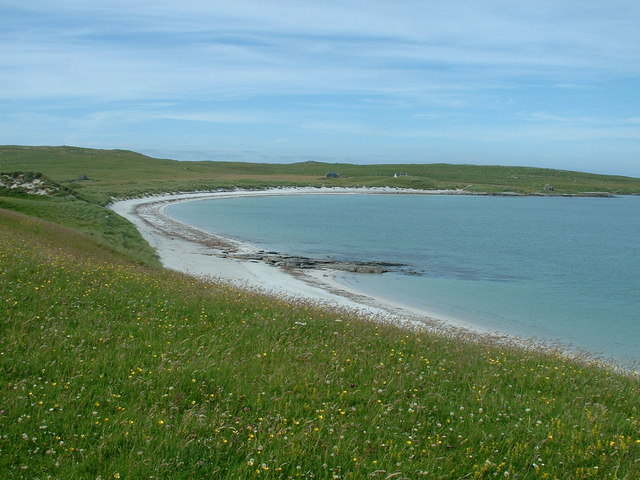
Stretching across the western edges of North Uist, Benbecula, and South Uist, the Uists’ Machair is one of the most extraordinary and ecologically rich landscapes in Scotland—and indeed the world. Found almost exclusively along the Atlantic coastlines of Scotland and western Ireland, machair is a rare type of coastal grassland formed by thousands of years of shell sand blown inland by relentless winds. The result is a landscape of gentle dunes, fertile plains, and flowering meadows that change dramatically with the seasons. Nowhere is this more expansive or more breathtaking than on the Uists, where the machair unfurls in wide, shimmering bands between the ocean and the loch-dotted interior. This environment is more than a natural wonder; it is a living collaboration between people and nature, shaped by ancient geology, traditional crofting practices, and the rhythms of the sea.
A Unique Geological Creation
The formation of machair is an intricate dance of natural forces. Over thousands of years, waves have ground seashells into a fine calcium-rich sand, which was then carried inland by powerful Atlantic winds. On the Uists, this process created sweeping coastal plains extending far beyond what is typical for dune systems. Unlike shifting sands found elsewhere, machair is stabilised by centuries of traditional farming—its fertility supported by the high calcium content of the blown shell fragments.
The Uists’ machair varies dramatically from north to south. In North Uist, it tends to be patchier and interwoven with the island’s rich mosaic of lochs and wetlands. On Benbecula and South Uist, the machair spreads out in grand, continuous fields that seem to stretch endlessly toward the horizon. The sandy soils, while light and porous, are surprisingly fertile, supporting some of the most diverse plant life in Britain. This makes the machair not only geologically rare but agriculturally valuable, especially in a region historically shaped by crofting and subsistence farming.
The Crofting Connection
What sets machair apart from many other ecosystems is the profound influence of traditional human activity. Far from degrading the land, traditional crofting, with its low-intensity grazing practices, rotational cultivation, and respect for seasonal cycles, has helped sustain the machair’s biodiversity for generations. The people of the Uists have long cultivated small patches of crops—often oats, barley, or rye—using seaweed as natural fertiliser. The gentle disturbance created by ploughing and grazing is crucial for many wildflower species that rely on open ground to germinate.
In summer, the machair bursts into colour, becoming a dazzling mosaic of orchids, daisies, buttercups, yarrow, and harebells. This abundance is not an accident; it is the result of centuries of careful coexistence between crofters and the land. Without crofting, much of the machair would quickly become dominated by coarse grasses, reducing both its beauty and its ecological value.
The relationship between crofters and the machair is deeply cultural as well. Many families continue to work the land as their ancestors did, maintaining the links between heritage, livelihood, and landscape. The local Gaelic identity is inseparable from this connection, and stories, songs, and traditions have long celebrated the machair’s beauty and bounty.
A Haven for Wildlife
The Uists’ machair is internationally recognised for its wildlife, supporting species that are rare or declining elsewhere in the UK. One of the most iconic is the corncrake, a shy and elusive bird whose rasping call becomes a soundtrack of late spring and early summer. The machair provides perfect cover for corncrakes during breeding season, thanks to its mosaic of long grasses and open, flower-rich fields.
Waders such as lapwings, redshanks, dunlins, snipe, and oystercatchers depend heavily on the machair and adjacent wetlands for feeding and nesting. In fact, the Uists support some of the highest densities of breeding waders anywhere in Europe. The shallow lochs and damp hollows behind the machair also attract wildfowl, including greylag geese and whooper swans.
But it is not only the birds that make the machair so special. The diverse plant communities support a rich assemblage of insects—particularly pollinators such as bees and butterflies. The machair’s flower blooms in summer are among the most spectacular anywhere in Britain, attracting naturalists, botanists, and photographers from across the world. The coastal fringes also provide habitat for rare plants such as the Hebridean spotted orchid and the Scottish primrose.
Marine life contributes too: the nearby waters of the Uists are frequented by seals, otters, and occasionally basking sharks, all of which add to the sense that this landscape is part of a grander, interconnected ecosystem.
Seasonal Rhythms and Changing Landscapes
The appearance of the machair changes profoundly with the seasons. In winter, storms whip across the Atlantic, reshaping dunes, eroding some sections of coastline, and depositing fresh sand on others. The grasslands turn pale golden, and the winds seem to sing through the dunes. Spring brings the first signs of life, with delicate wildflowers emerging from the sandy soils and birds returning to nest.
By midsummer, the machair is at its most vibrant. Fields shimmer with colour, and the air hums with insects. This is the season when the machair feels most alive—when crofters cut hay, children play on the long white beaches, and the sea glows in shades of turquoise and deep blue.
Autumn marks a period of retreat, as many birds begin their migrations and crofters harvest their final crops. Yet even in this quieter season, the machair remains dramatic and atmospheric, shaped constantly by the interplay between land and sea.
Environmental Challenges
Despite its beauty and resilience, the Uists’ machair faces significant environmental pressures. Coastal erosion, driven by rising sea levels and more frequent storms, threatens sections of the machair, especially in South Uist where some crofts have already lost land to the encroaching sea. Climate change also alters the conditions necessary for many of the species that depend on this habitat, potentially shifting the delicate balance between plants, wildlife, and crofting practices.
Changes in agricultural policy pose another challenge. As fewer young people enter crofting, some areas risk being abandoned or managed less intensively. Without the seasonal grazing and ploughing that support biodiversity, the machair could become less diverse and more uniform over time.
Conservation organisations, including local Scottish groups and international bodies, have been working alongside crofters to protect the machair. Projects focus on sustainable farming, habitat restoration, and monitoring vulnerable species. These efforts recognise that the machair is not simply a wild landscape but a cultural one—dependent on people who understand its rhythms.
A Landscape of Heritage and Identity
To walk along the machair of the Uists is to experience a landscape steeped in history, ecology, and tradition. It is a place where the salty wind carries echoes of past generations, where the meeting of sea and land forms a constantly shifting mosaic, and where natural beauty coexists with human stewardship. The machair is woven into the identity of the Uists and their people. It reflects a relationship between humans and the environment that is both ancient and sustainable, offering a powerful reminder of what can be achieved when landscapes are nurtured rather than exploited.
The Uists’ machair stands today as one of the last great examples of this rare and precious habitat. Its survival depends on the same harmony that created it—winds and waves from the Atlantic, the resilient communities who work the land, and the plants and animals that depend on its shifting sands. To preserve it is to safeguard not only a unique ecosystem but also the cultural memory of the Outer Hebrides themselves.
